Sandeep Shrestha
Two mountains. Two countries. Two completely different beasts. When climbers and armchair adventurers ask us which peak is the true king of pain, the answer is rarely what they expect. Mount Everest gets the headlines, but K2 quietly racks up the body count. As a Nepal-based team that has watched countless expedition teams stage from Kathmandu over the years, we want to give you the honest, ground-level comparison, not the Hollywood version.
This guide breaks down Everest vs K2 across every metric that matters: technical difficulty, fatality rates, weather, cost, and the human reality of climbing above 8,000 meters. Whether you're researching for a future expedition or planning a base camp trek, here's what the data and our field network tell us.
K2 is statistically more dangerous and technically harder than Everest. K2's fatality rate sits near 13-15% of summiteers, while Everest's hovers around 1-3%. However, Everest's 8,849-meter elevation creates extreme altitude challenges, and its commercial traffic introduces unique queuing and exposure risks not found on K2.
The ultimate guide to planning your dream web travel adventure with the experts from myeasyguide.
Spam free. Unsubscribe anytime. We respect your privacy.
Mount Everest |
K2 |
Elevation | 8,849 meters | 8,611 meters |
Country | Nepal / Tibet (China) | Pakistan / China |
Range | Mahalangur Himalaya | Karakoram |
First Summit | 1953 | 1954 |
Total Summits | ~12,000+ | ~700 |
Total Deaths | 330+ | 90+ |
Death Rate (per summit) | ~1-3% | ~15% |
Technical Grade | PD+ / AD (difficult) | D+ / TD (very difficult) |
Typical Expedition Cost | $45,000–$160,000 | $25,000–$75,000 |
Climbing Season | April–May, Sept–Oct | June–August only |
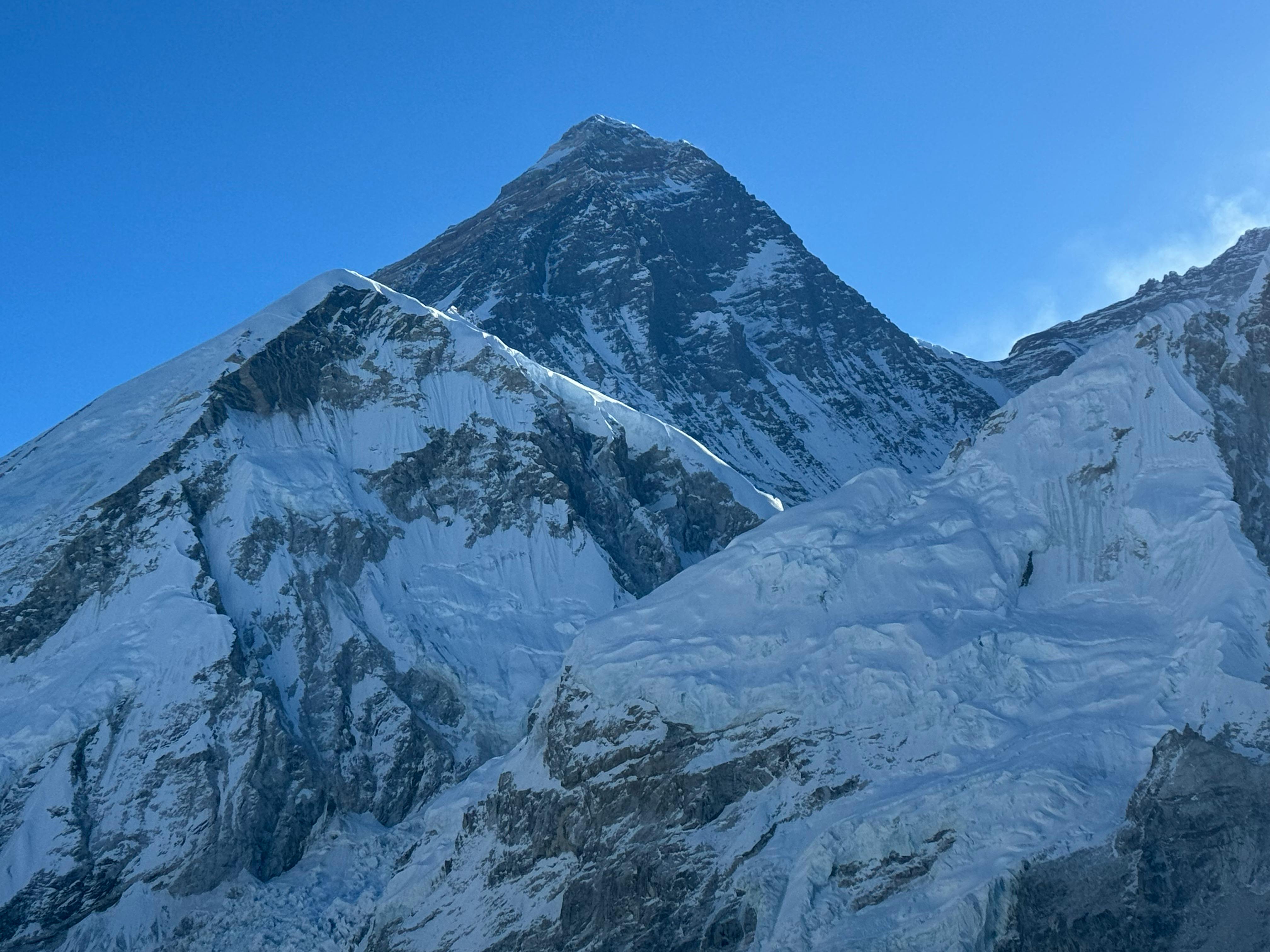
Source: Prabin Sunar
Majestic snow-covered peak of Mount Everest against a clear blue sky in the Himalayas.
Everest stands 238 meters taller than K2, but that gap matters more than it seems. The atmospheric pressure at Everest's summit is roughly one-third that of sea level, with available oxygen near 33% of normal. This is the legendary Death Zone above 8,000 meters, where the human body actively deteriorates with every hour spent.
On Everest, summit day from the South Col (Camp 4 at 7,920m) involves climbers spending up to 18 hours in the Death Zone. On K2, the Death Zone exposure is shorter due to higher camp placements, but the terrain is unforgiving, there's no rest, no plateau, no margin.
Both peaks demand months of acclimatization rotations. Sleep elevation increases of more than 300-500 meters per day above 3,000 meters trigger serious AMS risk. HAPE and HACE - the killer forms of altitude sickness, show no preference between Karakoram and Himalaya. They simply kill the unprepared.
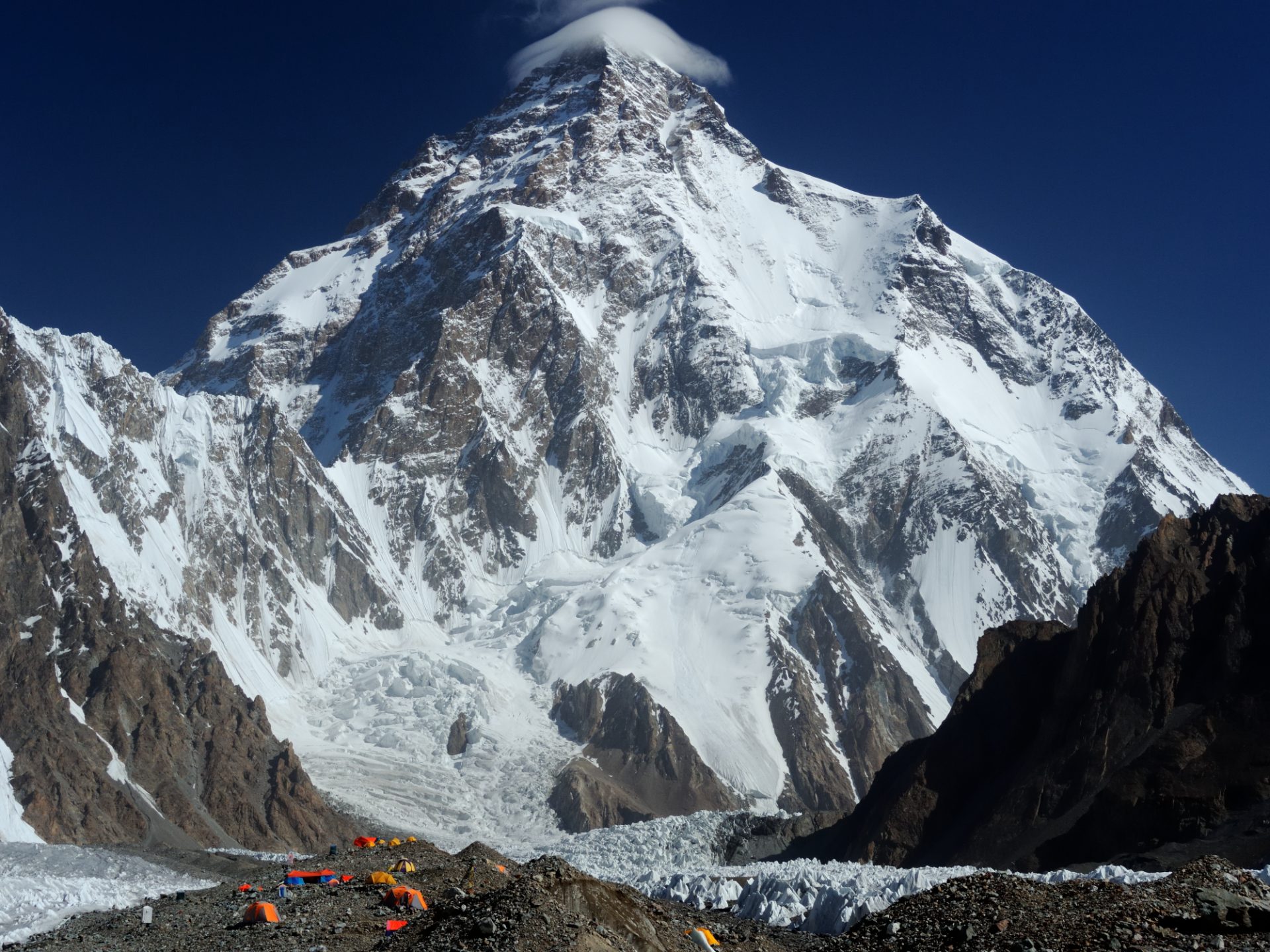
Source: Wikipedia
The steep, icy pyramid peak of Mount K2 mountain during a clear day.
K2 is significantly harder than Everest from a pure climbing standpoint. The standard Abruzzi Spur route on K2 demands sustained technical ice and mixed climbing at angles of 45-65 degrees, with no rest. Everest's South Col route is largely a walk-up with technical sections at the Khumbu Icefall, Lhotse Face, and Hillary Step.
On Everest, commercial expeditions install fixed ropes from base camp to summit each season. On K2, fixed lines exist only intermittently and are often re-rigged by whichever team arrives first. This difference alone explains much of the skill gap required.
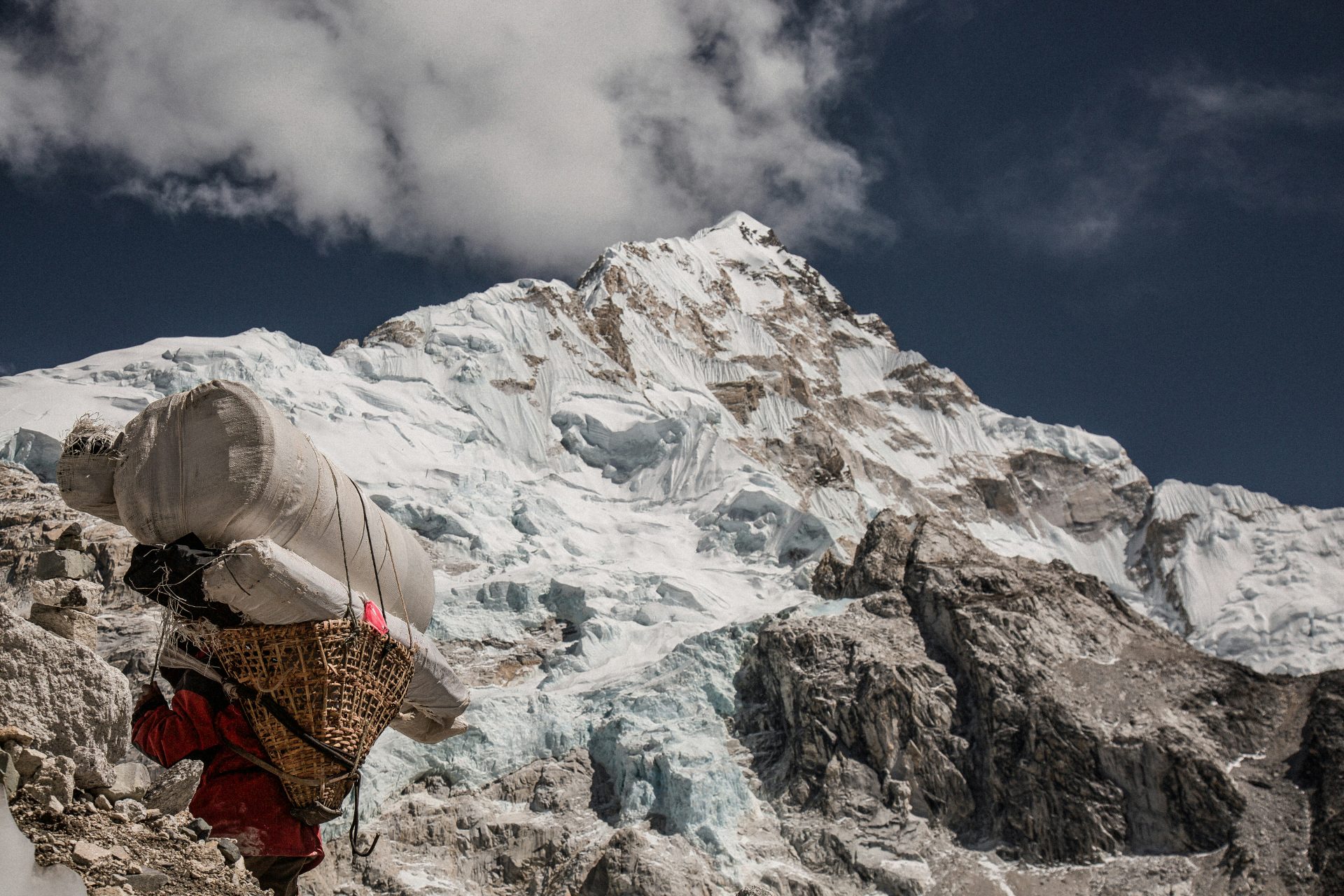
Source: Christopher Burns
A Himalayan Sherpa porter carrying a heavy load on a trekking trail in the Everest region.
K2's death rate is roughly 8-10 times higher than Everest's per summit attempt. While Everest has more total deaths due to far higher traffic volume, the proportional risk on K2 is staggering. Historically, for every four climbers who reach K2's summit, one dies somewhere on the mountain, most often during descent.
Our field contacts who have worked with Pakistani expedition operators consistently report that descent fatigue, weather pinning, and serac collapse account for the majority of K2 deaths. On Everest, the leading causes are exhaustion, AMS-related complications, falls, and increasingly, overcrowding and queue exposure near the summit ridge.
Modern Everest faces a problem K2 simply doesn't have: traffic. Some recent seasons have seen 400-500 climbers summiting in a single weather window. Photos of climbers queuing on the Hillary Step at 8,790m went viral for good reason, every extra hour in the Death Zone increases mortality risk substantially.
Everest offers two reliable climbing windows: pre-monsoon (April–May) and a smaller post-monsoon window (September–October). K2 has only one — a narrow band in July and August when the Karakoram jet stream lifts briefly. Some years, that window never opens, and entire expeditions return empty-handed.
K2's weather is notoriously volatile. Storms slam the Karakoram with little warning, and rescue operations are dramatically harder than on Everest. There is no equivalent of Lukla-style helicopter evacuation on K2, the nearest road head, Askole, is a 7-day trek from base camp.
Climbing Everest from Nepal costs significantly more than climbing K2, primarily due to permit fees, Sherpa wages, and infrastructure. A standard guided Everest expedition runs between $45,000 and $160,000 USD, while K2 expeditions typically fall between $25,000 and $75,000 USD.
However, K2 logistics are brutal. There are no teahouses, no permanent base camp infrastructure, and no Sherpa equivalent to handle load-ferrying. Everything moves on the backs of porters across the 62-kilometer Baltoro Glacier approach.
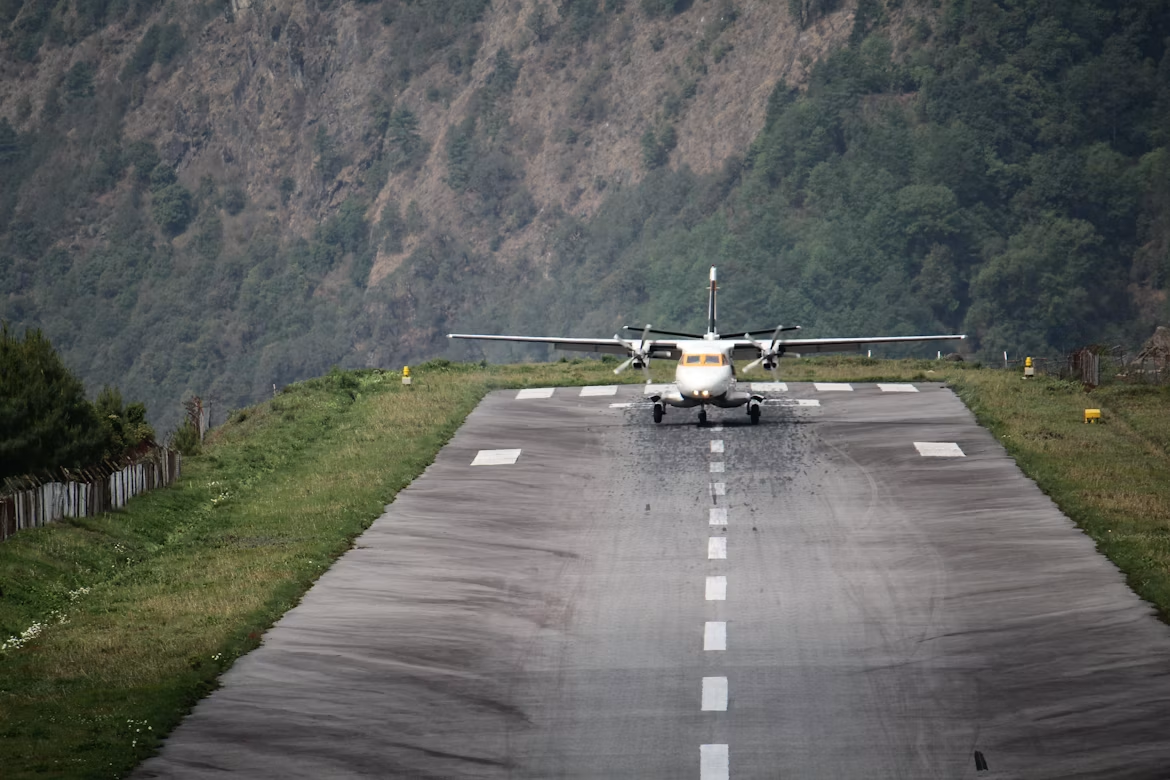
The Everest Base Camp approach is famously accessible. Climbers fly from Kathmandu (or Manthali Airport in Ramechhap during peak seasons March–May and September–November) to Lukla, then trek 8-10 days through Sherpa villages to base camp at 5,364m. Teahouses, bakeries, and Wi-Fi via Everest Link dot the entire route.
The K2 approach is a different universe. From Skardu, climbers drive a rough jeep track to Askole, then trek 7-8 days up the Baltoro Glacier through camps like Paiju, Urdukas, and Concordia before reaching K2 Base Camp at 5,150m. There are no lodges, no villages, no shops. Everything is carried, and porters often strike for better wages mid-expedition.
For travelers who want the Everest experience without the climbing risk, the EBC trek remains the most accessible way to stand at the foot of the world's highest mountain. Note that all major Nepal trekking regions now strongly enforce licensed guide requirements, verify current rules before booking.

Source: Sebastian Pena Lambarri
Local Sherpa guides carrying load on a rugged mountain pass along a Nepal trekking route.
Everest expeditions rely heavily on Sherpas, ethnic Nepalese mountaineers from the Khumbu region whose generational altitude adaptation and technical expertise are unmatched. K2 expeditions use High Altitude Porters (HAPs), often from the Hunza and Shimshal valleys. HAPs are skilled, but the support structure is less developed than the Sherpa system.
Tipping is culturally expected on both mountains. For commercial expeditions, plan to tip the crew between 15%–20% of the total trek or climb cost, distributed proportionally among guides, climbing Sherpas, and porters.
For Everest-region trekkers and climbers: ATMs do not exist past Namche Bazaar, so carry sufficient Nepalese Rupees. Nepal Telecom (NTC) is essential for connectivity in the Everest region. Expect to pay NPR 200–700 for charging power banks, hot showers, and Wi-Fi access at higher teahouses.
Hydration matters more than gear. Skip plastic bottled water, use a reusable bottle with UV purifiers, Sawyer filters, or chlorine dioxide drops. For food, stick to vegetarian meals at altitude. In the Khumbu, slaughtering animals is prohibited by local Buddhist law, so all meat is carried up over days without refrigeration. Dal Bhat, lentils, rice, and curry with free refills, is the safest, cleanest fuel on the trail.
Standard travel insurance is useless above 5,000 meters. Both Everest and K2 climbers, and even base camp trekkers, must carry insurance covering high-altitude helicopter evacuation up to 6,000m and full AMS/HAPE/HACE medical treatment. This is also legally required for obtaining Restricted Area Permits in Nepal's higher regions.
If you're approaching Everest from Nepal, the Khumbu is deeply Buddhist. Always pass mani stones, chortens, and stupas on the LEFT (keeping them to your right), and walk clockwise around religious structures. Remove shoes and hats before entering any monastery, and never photograph inside prayer halls without explicit permission from a resident monk.
K2 is harder. Full stop. It demands more technical skill, more autonomy, more luck with weather, and a higher tolerance for objective danger. Everest is more accessible, better supported, and statistically safer per attempt, but it's also taller, more crowded, and exposes climbers to longer Death Zone durations. They are not the same challenge; they're two distinct tests of human limits.
For aspiring mountaineers, the standard progression is clear: build skills on lower 6,000m and 7,000m peaks, summit a less technical 8,000er like Manaslu or Cho Oyu, then attempt Everest. K2 should only follow several successful 8,000m climbs.
Yes. Historically, K2’s fatality rate loomed near 25%, though a surge in modern commercial support has brought the overall statistical average closer to 13–15%, still vastly outshadowing Everest’s 1–3%. Proportionally, K2 is one of the deadliest 8,000m peaks on Earth.
No. Both require expert mountaineering skills and prior 8,000m experience. However, non-climbers can trek to Everest Base Camp at 5,364m as one of the world's premier trekking experiences.
K2 has steeper sustained technical climbing, exposed avalanche terrain at the Bottleneck, no continuously fixed ropes, harsher weather, and a single narrow summit window each year.
Everest has over 330 recorded deaths due to vastly higher climber traffic. K2 has roughly 90+ deaths, but the death-to-summit ratio is far higher.
Yes, but it's significantly tougher. The K2 Base Camp trek in Pakistan is a 14-21 day expedition via the Baltoro Glacier, with no teahouse infrastructure, only tented camps.
The Everest Base Camp trek in Nepal is the most accessible and cost-effective way to stand at the foot of an 8,000m giant. Most travelers complete it in 12-14 days with a licensed local guide.