Asmita Karki
Standing on the Kongma La at first light, watching the Lhotse wall glow orange while your fingertips burn through gloves at minus fifteen, that's the moment the Three Passes Trek stops being a checklist item and becomes the single hardest thing you've ever asked your body to do. We get this question every week through our marketplace: is the Three Passes Trek actually harder than Everest Base Camp, or is that just marketing?
Short answer from our field coordinators in Namche: yes, dramatically harder. And not in the ways most blogs describe. This 2026 review breaks down the honest difficulty, the new regulatory landscape, and whether your fitness, experience, and budget realistically match the route.

Source: Christopher Burns
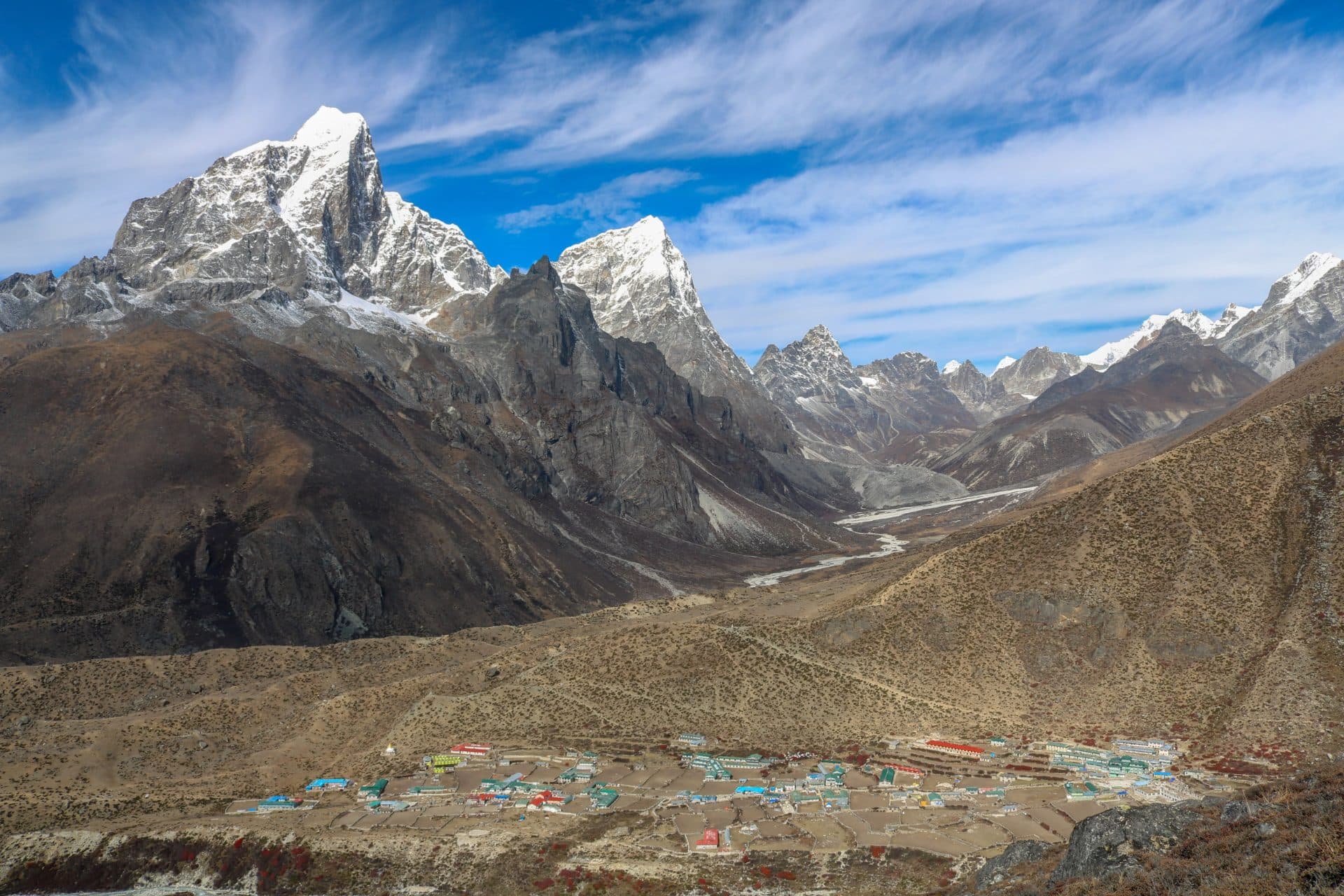
A Himalayan Sherpa porter carrying a heavy load on a trekking trail in the Everest region.
The Everest Three Passes Trek is roughly 40-50% harder than the standard EBC route. It takes 18-22 days versus 12-14 days, crosses three passes above 5,300 meters, and demands glacier travel, scree scrambling, and exposed ridge walking. EBC is primarily a high-altitude trekking route on established trails, while the Three Passes route introduces far more demanding terrain, including glacier crossings, steep scree descents, icy sections, and exposed high passes that require strong fitness, balance, and altitude tolerance. It remains a non-technical trek in normal conditions, but it is significantly more demanding than standard EBC.
Even with a porter, expect to carry a 5–8 kg daypack containing water, insulation, waterproof layers, snacks, documents, and emergency essentials during every pass crossing.
The route loops through the entire Khumbu, traversing three high cols that connect the major valleys: Kongma La (5,535m), Cho La (5,420m), and Renjo La (5,360m). Most trekkers also tag Everest Base Camp and summit Kala Patthar along the way, plus optional Gokyo Ri.
Where EBC trekkers turn around at Gorak Shep and retrace their steps to Lukla, Three Passes trekkers push laterally across alpine terrain that other groups never see. You'll cross frozen streams at dawn, navigate the rubble-covered Ngozumpa Glacier (the longest glacier in Nepal), and descend boot-grabbing scree fields where a slip means real consequences.
The ultimate guide to planning your dream web travel adventure with the experts from myeasyguide.
Spam free. Unsubscribe anytime. We respect your privacy.
Source: Wikipedia
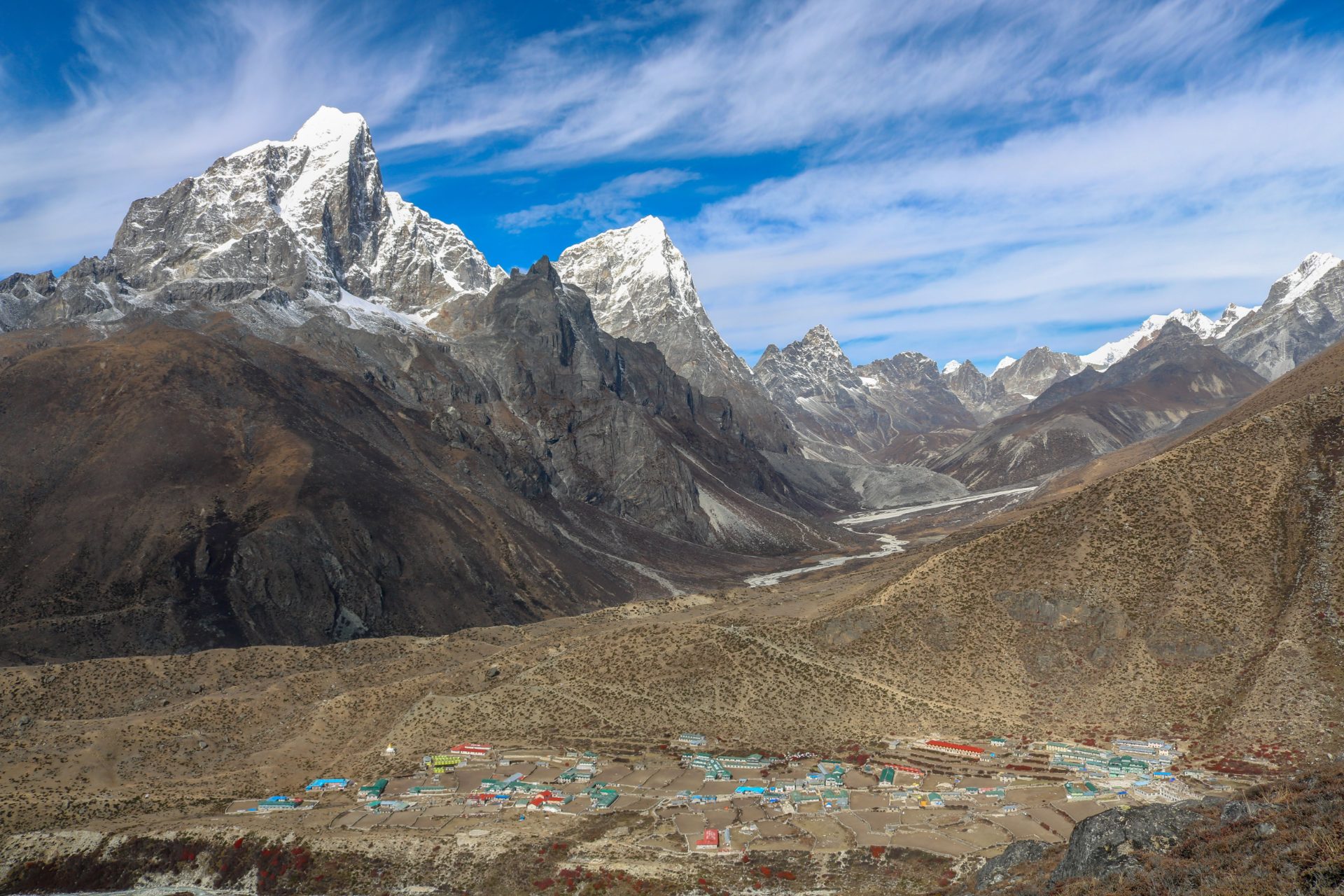
Stone-walled fields and mountain lodges in Dingboche village below Ama Dablam peak on the way to Everest base camp.
The classic Everest Base Camp trek tops out at 5,545m on Kala Patthar but does so on a wide, well-trodden, mostly graded trail. The classic EBC route does not normally require glacier travel equipment or technical climbing skills in peak trekking seasons. Lodges are larger, food options broader, and the trail is rarely empty.
In standard spring and autumn conditions, most trekkers cross Cho La using microspikes rather than full mountaineering crampons. After heavy snowfall or ice storms, guides may adjust routes or delay crossings until conditions stabilize.
EBC is hard because of altitude and distance, full stop. Three Passes is hard because of altitude, distance, technical terrain, weather exposure, longer days above 5,000m, and the cumulative fatigue of a three-week itinerary. The difference compounds.
EBC includes two scheduled acclimatization days (Namche and Dingboche). Three Passes itineraries squeeze in those rest days plus longer trekking days of 7-10 hours in thin air. By day 14, when you're starting your Cho La approach, you've already done more vertical gain than a complete EBC trekker.
For the entire Khumbu region, including the full Three Passes circuit, you need exactly two permits:
Note: The Khumbu region does NOT use the standard e-TIMS QR card that you'd need for Annapurna or Manaslu. This trips up many first-time trekkers.
Nepal's tourism authorities continue to strengthen licensed guide enforcement across major trekking regions. Guide enforcement in the Khumbu has historically been less strict than in restricted areas like Manaslu or Upper Mustang, but policies and local enforcement can change. Always verify the latest requirements before departure. The technical nature of Cho La and Renjo La makes solo travel a genuine safety risk. Our field contacts strongly recommend booking a licensed guide for any Three Passes itinerary. Always verify current solo-trekking rules with your agency before departure.
Source: Rajan Dahal
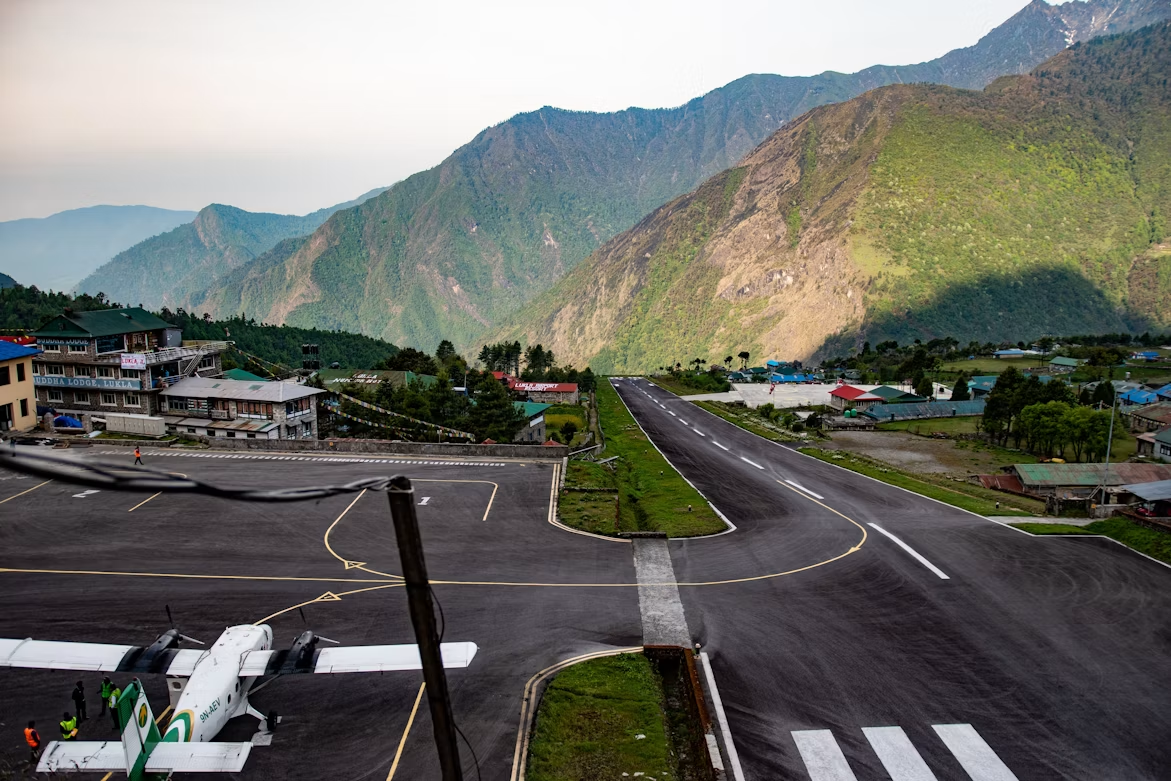
Wide angle shot of the short, angled runway at Tenzing-Hillary Airport in Lukla, gateway to Everest Base Camp.
During peak seasons, March to May and September to November, flights to Lukla operate from Manthali Airport in Ramechhap, not Kathmandu. This means a 4-5 hour jeep transfer leaving Kathmandu around 1:00 AM to catch the dawn departure window.
Build 1-2 buffer days into both ends of your trip. Weather cancellations are routine, and missing your international return flight because of a Lukla delay is a heartbreak we see every season. Expect domestic flight costs in the realistic range commonly quoted by agencies, confirm live pricing through your marketplace operator.
This itinerary respects the 300-500 meter daily sleep-elevation gain rule above 3,000m, with two mandatory acclimatization days. Compressed 15-day itineraries exist, but our field coordinators consistently report higher AMS evacuation rates on those rushed schedules.
Unlike the standard EBC trek, the Three Passes route rewards lightweight efficiency. Waterproof gloves, microspikes, trekking poles, and a genuinely warm down jacket matter far more than extra clothing. Wind exposure above 5,000 meters can turn minor gear mistakes into serious cold injuries.
The Three Passes route keeps you above 4,500m for nearly two straight weeks. That cumulative exposure is where AMS, HAPE, and HACE risks compound. EBC trekkers come down after a few days at altitude; Three Passes trekkers cross another 5,400m+ col every two to three days.
Standard travel insurance is not enough. You need a policy that explicitly covers:
This isn't optional advice, it's the difference between a $200 evacuation flight you can claim back and a $5,000 bill you eat personally. Poor weather can prevent helicopter evacuations for hours or even days in the Khumbu. Insurance is essential, but weather windows ultimately determine evacuation speed.
Above 5,000 meters, even simple tasks become physically draining. Appetite drops, sleep quality worsens, dehydration increases, and recovery slows dramatically. Many trekkers underestimate how cumulative fatigue compounds after two straight weeks at altitude.
Strong trekkers still turn back on Three Passes every season. Persistent AMS symptoms, unstable weather, exhaustion before a pass day, or fresh snowfall are all valid reasons to reroute onto the standard EBC trail. In the Khumbu, good decision-making matters more than summit mentality.
ATMs exist in Namche Bazaar but become unreliable past that point. Carry enough Nepalese Rupees in cash for the full circuit beyond Namche, including a buffer for emergencies and tips. Our standard guidance: budget realistically for daily teahouse expenses and add roughly 30% for incidentals.
Lodge stays in the Khumbu rarely include the comforts you'd expect. Plan for these add-ons:
For mobile coverage, Nepal Telecom (NTC) is the reliable choice in the Everest region. Buy a SIM in Kathmandu with a data package. Signal drops near the high passes but returns in major villages.
The Khumbu region is spiritually Buddhist, and slaughtering animals is locally prohibited. All meat consumed in lodges is carried up by foot or mule over days without refrigeration. Our standing advice: go vegetarian above Namche. The risk of gastrointestinal illness from trail meat is real, and a stomach bug at 5,000m ends treks.
Stick to Dal Bhat, lentil soup, rice, and vegetable curry, often with free refills. It's clean, high-energy, locally grown, and exactly what your body needs for a 7-hour trek day.
Accommodation bottlenecks are more serious on the Three Passes route than on standard EBC because villages like Dzongla, Thagnak, and Lungden have far fewer beds. During October and November, arriving late in the afternoon can leave trekkers sleeping in dining halls.
Do not buy plastic bottled water. Carry reusable bottles and an active purification system: a UV purifier (Steripen), Sawyer squeeze filter, or chlorine dioxide drops. Teahouses sell boiled water cheaply, and this approach saves money and respects the fragile Khumbu environment.
Most experienced Khumbu guides run the circuit counterclockwise via Kongma La → Cho La → Renjo La. This sequence allows better acclimatization before the technically harder Cho La crossing and places the gentler Renjo La later in the trek when fatigue is highest.
You'll pass mani stones, chortens, and stupas constantly on this circuit. Always pass them on the LEFT side, keeping the structure to your right, and walk clockwise around all religious monuments. This is non-negotiable cultural practice.
Inside monasteries, Tengboche being the most-visited, remove shoes and hats. Photography inside prayer halls is strictly prohibited unless a resident monk explicitly grants permission. Donations to monasteries (NPR 200-500) are appreciated but never demanded.
Tipping is culturally expected in Nepal and forms a vital portion of guide and porter income. Standard marketplace guidance: budget 15%-20% of your total trek cost distributed among the crew at the end of the trip. For a Three Passes trek with one guide and one porter over three weeks, this is meaningful money, and rightfully so given what they carry and the risks they share with you.
Honest answer: not first-time Himalayan trekkers. We recommend Three Passes only if you meet these criteria:
If you're newer to high-altitude trekking, do EBC first. There's no shame in this, and many of our repeat clients return for Three Passes specifically because EBC built their confidence and conditioning.
If your dates fall in monsoon, redirect your trip entirely. Upper Mustang and Upper Dolpo sit in the Himalayan rain shadow and offer premier dry trekking exactly when the Khumbu is socked in.
Fresh snowfall can temporarily close Kongma La, Cho La, or Renjo La even during peak trekking months. Weather-related delays of 1–2 days are not uncommon in late autumn or early spring.
The Three Passes Trek delivers an Everest experience that EBC simply cannot match. You see the entire Khumbu, every valley, every angle, every ridgeline, and you do it on trails where outside peak October windows, some sections between passes can feel dramatically quieter than the main EBC corridor. The view from Renjo La back across to Everest is, in our coordinators' shared opinion, the single best mountain view in Nepal.
But it's harder. Substantially harder. The right answer depends on your honest fitness, prior altitude experience, time budget, and tolerance for cold technical days. Don't let ego push you onto Three Passes if EBC is the smarter call. Don't let caution hold you back if you've earned this route.
Nepal continues to enforce stricter licensed-guide requirements across major trekking regions. Given Cho La's glacier crossing and route-finding on Kongma La, hiring a licensed guide is strongly recommended regardless of any technical solo permission. Verify the latest rules with your agency before booking.
Comfortably hike 15-20 km with elevation gain over consecutive days at home. Build in cardio for 3-6 months before departure. Stair-climbing with a weighted pack mimics the trail well.
The Kongma La crossing from Chhukung to Lobuche is widely considered the toughest single day, roughly 9-11 hours with 1,200m of gain and a steep, exposed descent on scree.
Namche Bazaar has ATMs but they're unreliable and often offline. Treat them as backup only and carry sufficient NPR cash from Kathmandu for the full circuit.
Microspikes are strongly recommended for Cho La, especially in spring and late autumn when the glacier ice is exposed. Many guides carry a shared set; confirm before departure.
Costs vary significantly by season, agency, and inclusions. The Three Passes trek typically runs higher than EBC due to extra days, guide time, and lodge nights. Request live quotes from verified operators rather than relying on outdated blog figures.