Travel Guide
Hot Showers, WiFi & Charging on Nepal Treks 2026: What's Available & What It Costs
AD
Arati Dawadi
11 min read
Arati Dawadi
There is a moment on every long trek when your phone hits 12 percent, the only socket in the dining room is already taken, and the teahouse owner quietly mentions that a hot shower will cost extra. None of this is a problem if you know it is coming. It becomes a real headache if you assumed your nightly room rate covered everything.
Our field coordinators track these costs constantly across the Everest, Annapurna, Manaslu, and Mustang regions, because the small daily charges for power, water, and connectivity are the costs trekkers most often forget to budget. This guide lays out exactly what is available in 2026, what it costs, and how to keep those rupees from disappearing faster than you expect.
Hot showers, charging, and WiFi are almost never included in your teahouse room rate. Expect to pay NPR 200 to 700 per service, billed separately each time. Gas showers cost more at higher elevations, charging runs NPR 200 to 500 per device, and WiFi networks like Everest Link require prepaid cards.
The single most important thing to understand is the trail micro-economy. Everything you use in a teahouse beyond a bed and a meal is an add-on. Lodges keep room rates low because they make their margin on food, charging, water, and warmth.
These ranges shift with season and demand, so treat them as planning figures rather than fixed prices. Always carry more cash than the table suggests.
Hot showers are widely available up to the mid-trek villages but become expensive and unreliable at altitude. Gas-heated showers cost NPR 300 to 700 because cooking gas is carried up by porter or mule. Solar showers are cheaper but depend entirely on a sunny afternoon, which high mountain weather rarely guarantees.
The higher you climb, the colder the air and the more a hot shower costs to heat. In villages like Lobuche or Thorong Phedi, a steaming wash is a genuine luxury, and many trekkers skip it entirely above 4,500 meters to avoid catching a chill that can complicate acclimatization.
Most experienced trekkers buy a thermos of hot water for NPR 100 to 500 and do a quick bucket wash in their room instead of paying for a full shower. It is cheaper, warmer, and far safer than standing wet in a cold outdoor stall at altitude.
Pack a fast-drying travel towel and a small bottle of biodegradable soap. Baby wipes between proper washes are the unofficial standard for keeping clean on high routes where bathing is impractical.
Device charging is available in nearly every teahouse but is billed per device, usually NPR 200 to 500 for a full charge. Prices climb with altitude because remote lodges run on solar panels and small generators with limited capacity. Free charging is rare above the lower trailhead villages.
The smart move is to arrive self-sufficient. A high-capacity power bank of 20,000mAh or more will keep a phone alive for several days. Pair it with a lightweight folding solar panel clipped to your backpack, and you can essentially skip paying for charging on most days.
Lithium batteries drain fast in the cold. Sleep with your phone, camera batteries, and power bank inside your sleeping bag, and they will hold their charge dramatically better. Keep devices in an inner jacket pocket during the day rather than an exposed outer pocket.
If you are shooting a lot of photos or relying on GPS, budget realistically. Over a two-week Everest trek, paying to charge a phone and a camera daily can quietly add NPR 8,000 or more to your bill.
WiFi on Nepal trails is patchy and almost always paid. In the Everest region, the Everest Link network dominates and requires a prepaid card. Daily-use cards cost NPR 800 to 1,500, while the more practical 30-day data packages (10 GB or 20 GB) run NPR 2,700 to 4,000 and are the better value for a full trek.
Mobile data from Ncell or Nepal Telecom (NTC) is often faster and cheaper than teahouse WiFi where coverage exists.
Coverage varies sharply by region, and choosing the right SIM card before you leave Kathmandu or Pokhara saves a lot of frustration on the trail. Buy your SIM at a registered shop with your passport and a photo, and have the staff activate a data pack before you set off.
Many of our trekkers carry both an Ncell and an NTC SIM for redundancy. If one network drops in a valley, the other often picks up. For deeper logistics planning, our guide to high-altitude trekking logistics covers connectivity alongside acclimatization planning.
No reliable ATMs exist past Namche Bazaar in the Everest region or Jomsom in Annapurna. Every shower, charge, WiFi card, snack, and tip is paid in Nepalese Rupees cash. Withdraw enough in Kathmandu or Pokhara before your trek, and carry it in small denominations across multiple pockets and bags.
Card machines on the trail are essentially nonexistent, and the few that claim to exist charge punishing fees and often fail due to weak connectivity. Treat cash as a non-negotiable part of your packing list. Running out at altitude means you cannot pay for warmth, water, or a charge when you need them most.
Beyond food and lodging, plan for NPR 1,500 to 3,000 per day in extras once you factor in charging, a shower, hot drinks, WiFi, and bottled-free water purification supplies. Over a longer trek these small charges become a meaningful chunk of your overall spend.
Do not buy plastic bottled water on the trail. It creates a waste problem the mountains cannot absorb and gets expensive at altitude. Instead, carry a reusable bottle paired with an active purification system such as a UV purifier, a Sawyer squeeze filter, or chlorine dioxide drops, and refill from teahouse taps or streams.
Buying hot or boiled water from a teahouse for NPR 100 to 500 per litre is a cleaner alternative when you want a warm drink, and it doubles as a hand-warmer in your bottle overnight. The Khumbu region has serious waste challenges, as our reporting on trash on Everest makes clear.
None of these comfort costs change the core regulations. As of 2026, all foreign trekkers in Nepal's national parks and conservation areas are legally required to hire a licensed guide through a TAAN-registered agency, this covers Everest, Annapurna, Langtang, and Manaslu, not just restricted zones.
Permit fees are fixed by the government and must be paid regardless of how you handle showers and charging. For the Everest region, there is no standard e-TIMS card. You pay the Khumbu Pasang Lhamu Municipality fee of NPR 3,000 plus the Sagarmatha National Park Permit of NPR 3,000.
The ACAP permit covers the Annapurna region. Restricted areas like Manaslu, Upper Mustang, and Tsum Valley now allow a single traveler to obtain a Restricted Area Permit, a March 2026 rule change removed the previous two-person minimum, but a licensed guide hired through a registered agency remains mandatory.
Standard travel insurance is not enough. You need a policy that specifically covers high-altitude emergency helicopter evacuation up to 6,000 meters and treatment for AMS, HAPE, and HACE. This is legally required to obtain Restricted Area Permits, so sort it before departure.
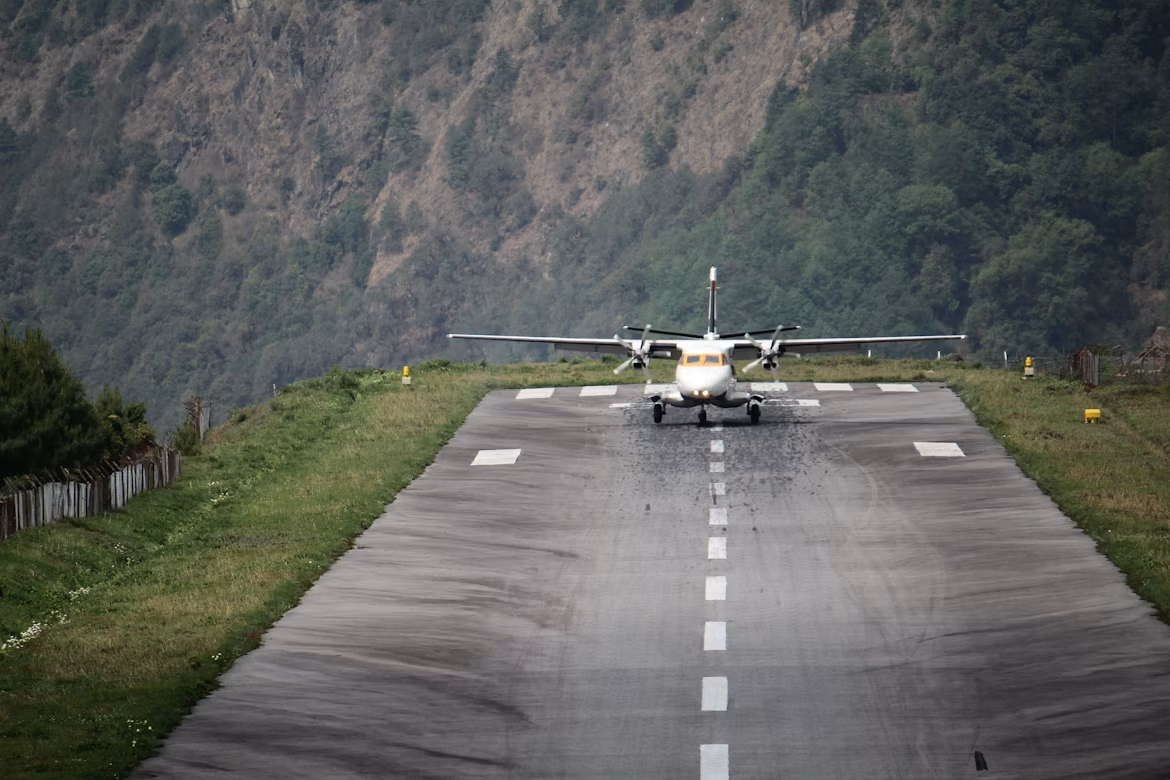
If you are heading to Everest during peak seasons, March to May and September to November, flights to Lukla operate from Manthali Airport in Ramechhap, not Kathmandu. That means a 4 to 5 hour overnight drive leaving between 1:00 AM and 2:00 AM to catch a morning flight. Build 1 to 2 buffer days into your plan for weather delays.
Once you land, the charging and WiFi clock starts ticking. Top up your power banks and buy your data pack while you still have reliable mains power and signal in Lukla or Namche.
As you move through Buddhist villages, always pass mani stones, chortens, and stupas on the LEFT, keeping them to your right, and walk clockwise around religious structures. Remove your shoes and hat before entering any monastery, and never photograph inside prayer halls unless a resident monk gives you clear permission.
These courtesies cost nothing but mean everything to the communities hosting you. The same goes for tipping your crew at the end, which is culturally expected. A standard range is 15 to 20 percent of your total trek cost, distributed among guides and porters.
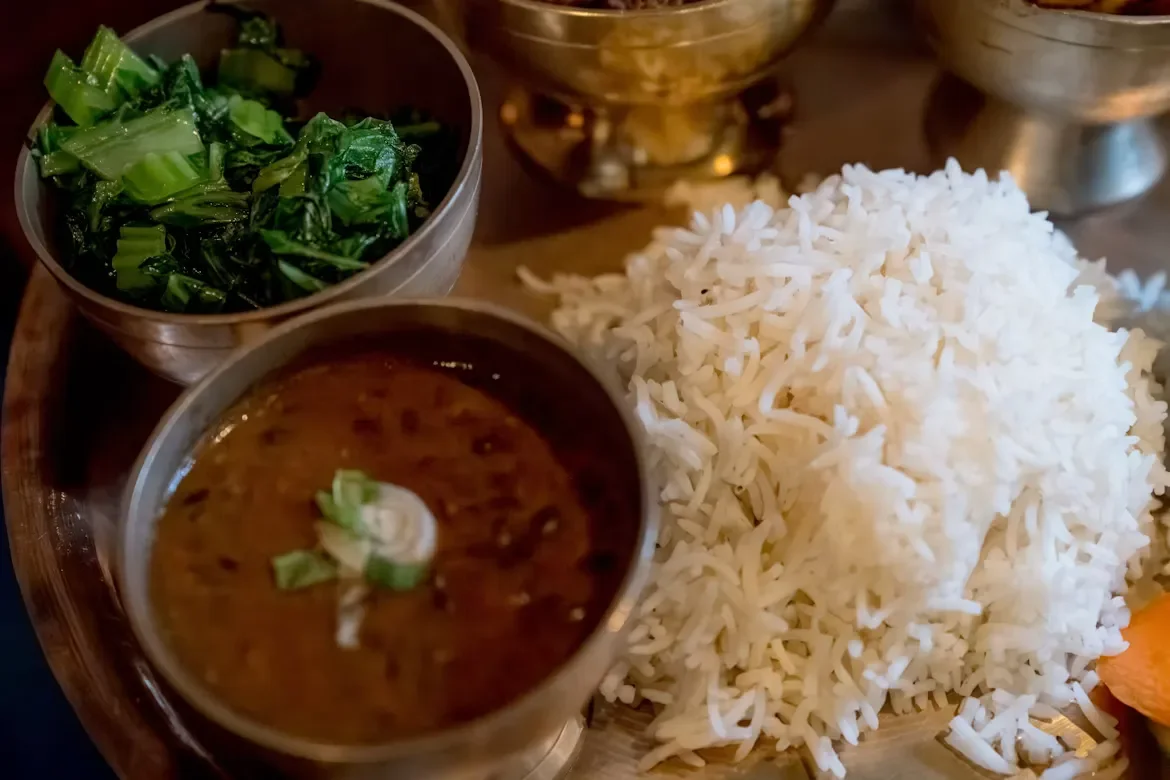
Prioritize vegetarian meals on the trail. In Buddhist regions like the Khumbu, slaughtering animals is prohibited by local law, so all meat is carried up by foot or mule over days without refrigeration. Stick to fresh, locally grown carbohydrates, and lean on the classic Dal Bhat, which comes with free refills and gives you clean, steady energy for long climbing days.
Eating well also keeps your body resilient to the cold, which reduces how often you feel you absolutely need that expensive hot shower in the first place.
Comfort on a Nepal trek is available almost everywhere, but it is rarely free and never automatic. Carry enough cash, bring a power bank and solar panel, choose the right SIM, purify your own water, and you will sidestep both the surprise charges and the small daily stress of running low on power. For region-specific planning, our overviews of the Everest region and Annapurna region break down what to expect village by village, and our full trek packing list covers the gear that keeps you self-sufficient.
No. Expect to pay an extra NPR 200 to NPR 800 per service. Prices increase with altitude due to high solar, generator, and portered gas costs.
Bring a 20,000mAh+ power bank and a foldable solar panel for your backpack. Sleep with your electronics inside your sleeping bag to prevent cold weather battery drain.
Avoid full showers above 4,500 meters. Teahouse bathrooms are unheated; standing wet in freezing air risks deep chills and respiratory infections like the "mountain cough."
No. Reliable ATMs end in Kathmandu and Pokhara. Trail card machines do not exist. Carry 100% of your budget in Nepalese Rupees (NPR) cash.
Via Everest Link prepaid data cards. Skip the daily cards and buy a 30-day package (10GB–20GB for NPR 2,700–4,000) for the best value.
Yes. All foreign trekkers must hire a licensed guide through a registered agency to trek in national parks and conservation areas (Everest, Annapurna, etc.). Independent solo trekking is illegal.
You need two local permits (the standard TIMS card is not used):
Yes. The old two-person minimum group rule is gone for areas like Manaslu and Upper Mustang. However, you are still legally required to hire a licensed guide.
To reduce airport congestion in Kathmandu during peak seasons (March–May, Sept–Nov). Budget for a 4-to-5-hour midnight drive from Kathmandu to reach Ramechhap for your morning flight.
Get travel ideas and local experiences from My Easy Guide in your inbox.
Spam free. Unsubscribe anytime. We respect your privacy.