Travel Guide
Paragliding in Pokhara 2026: Cost, Best Season & What to Expect
PT
Prabesh Tamang
9 min read
Prabesh Tamang
Picture yourself running off the green shoulder of Sarangkot ridge, the ground falling away beneath your feet, and then the harness gently takes your weight as the wing lifts. Below you sits Phewa Lake, mirror-flat and turquoise, and ahead the white wall of the Annapurna range fills the horizon. This is why Pokhara is ranked among the top five tandem paragliding destinations on the planet.
We coordinate flights here every season, and our field contacts track operator rates, weather windows, and the small logistical details that decide whether your flight is magical or rushed. Here is everything you need to plan paragliding in Pokhara for 2026.
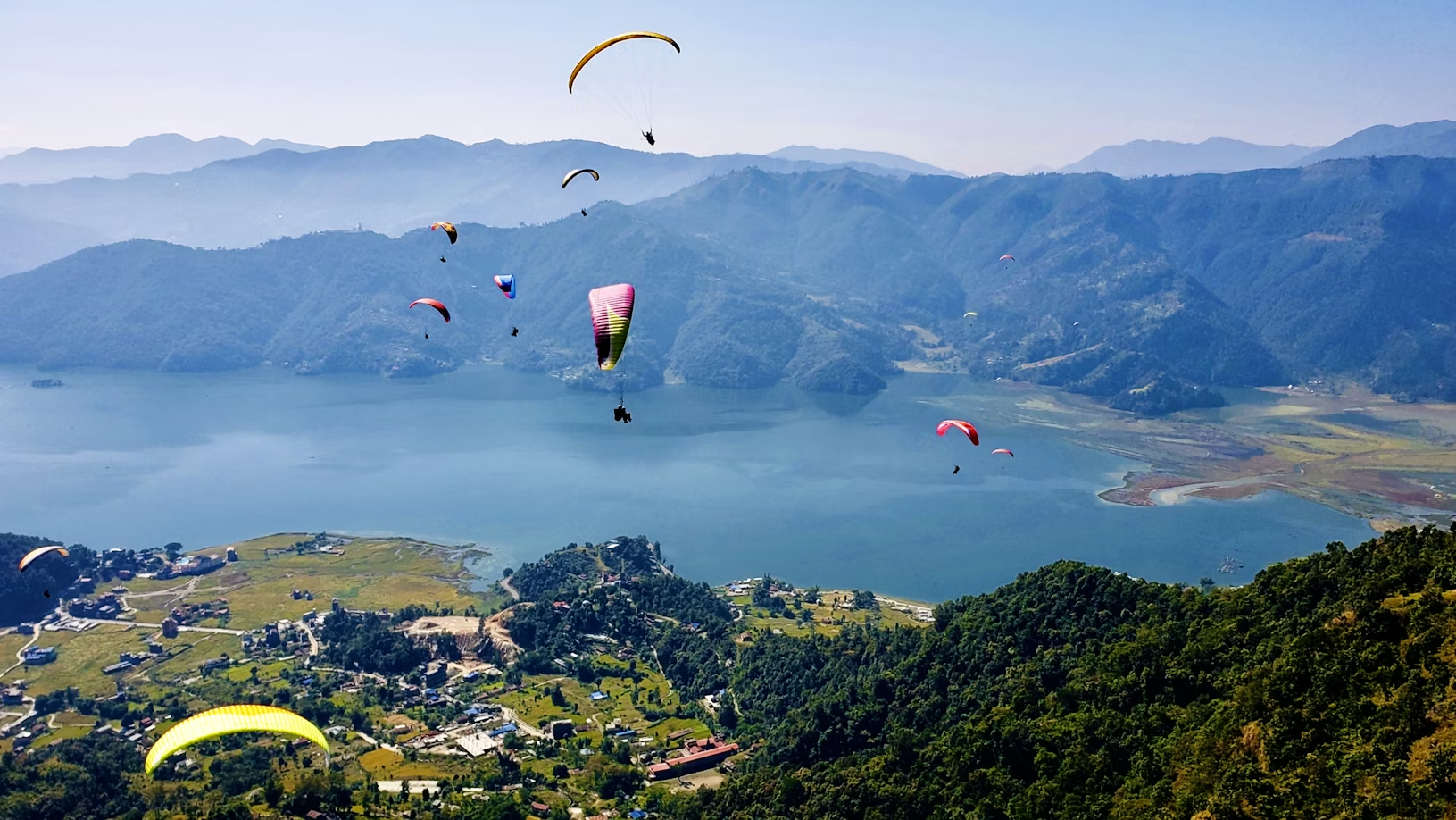
A standard tandem paragliding flight in Pokhara costs roughly USD 70 to USD 100 per person for 20-30 minutes of airtime. Cross-country and acrobatic flights run higher. Prices fluctuate with season, demand, and package inclusions, so always verify live rates through your operator or our marketplace before booking.
Pokhara paragliding pricing is fairly standardized across registered operators, but the variation comes from flight type and the photo/video add-on. Here is a realistic 2026 breakdown.
Most operators bundle a GoPro photo and video package for an extra $20 to $35, captured on a pole the pilot holds. We recommend taking it; you cannot easily film yourself while flying, and the footage of the Himalaya behind you is worth the small cost.
Note that a tourist visa is a separate expense if you are flying in from abroad. Nepal charges $30 USD for a 15-day visa, $50 USD for 30 days, and $125 USD for 90 days on arrival.
Many lakeside operators accept cards and digital payments, but card readers fail and some add a surcharge. Carry enough Nepalese Rupees (NPR) as a backup. If you pre-book online through a marketplace, you lock the price in advance and avoid the last-minute haggling that happens at the lake.
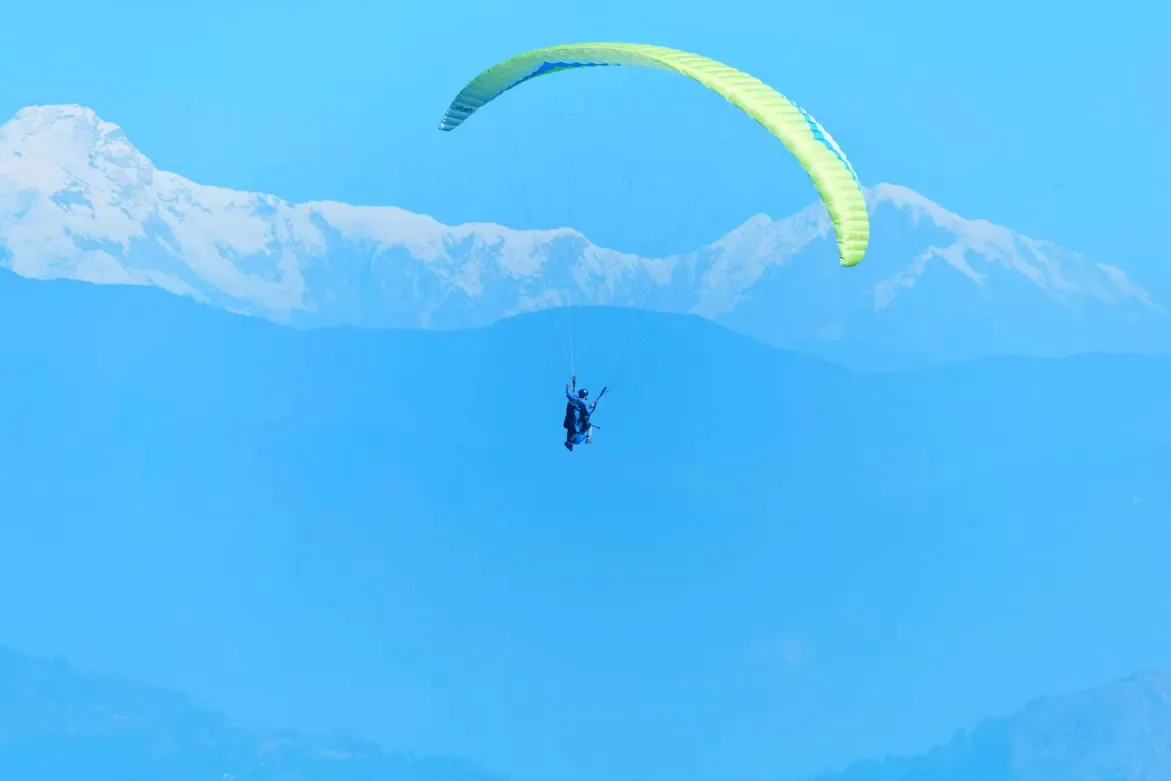
The best season for paragliding in Pokhara is late September to mid-December and again February to April. These months deliver clear skies, reliable thermals, and unobstructed mountain views. The monsoon from June to August brings heavy cloud, rain, and frequent cancellations.
Autumn is the single best window if you want the postcard view of Machhapuchhre and Annapurna standing crisp on the horizon. Spring offers stronger thermals for longer airtime, but afternoon haze can soften the mountain views. If you are also planning trekking around your visit, our note on the difference between September and October is worth a read.
Morning flights, roughly 9:00 AM to 11:00 AM, give you the calmest, smoothest air and the clearest mountain visibility before clouds build. Midday flights catch the strongest thermals, which means more lift and longer airtime but bumpier air. If you get motion sickness easily, book the early morning slot.
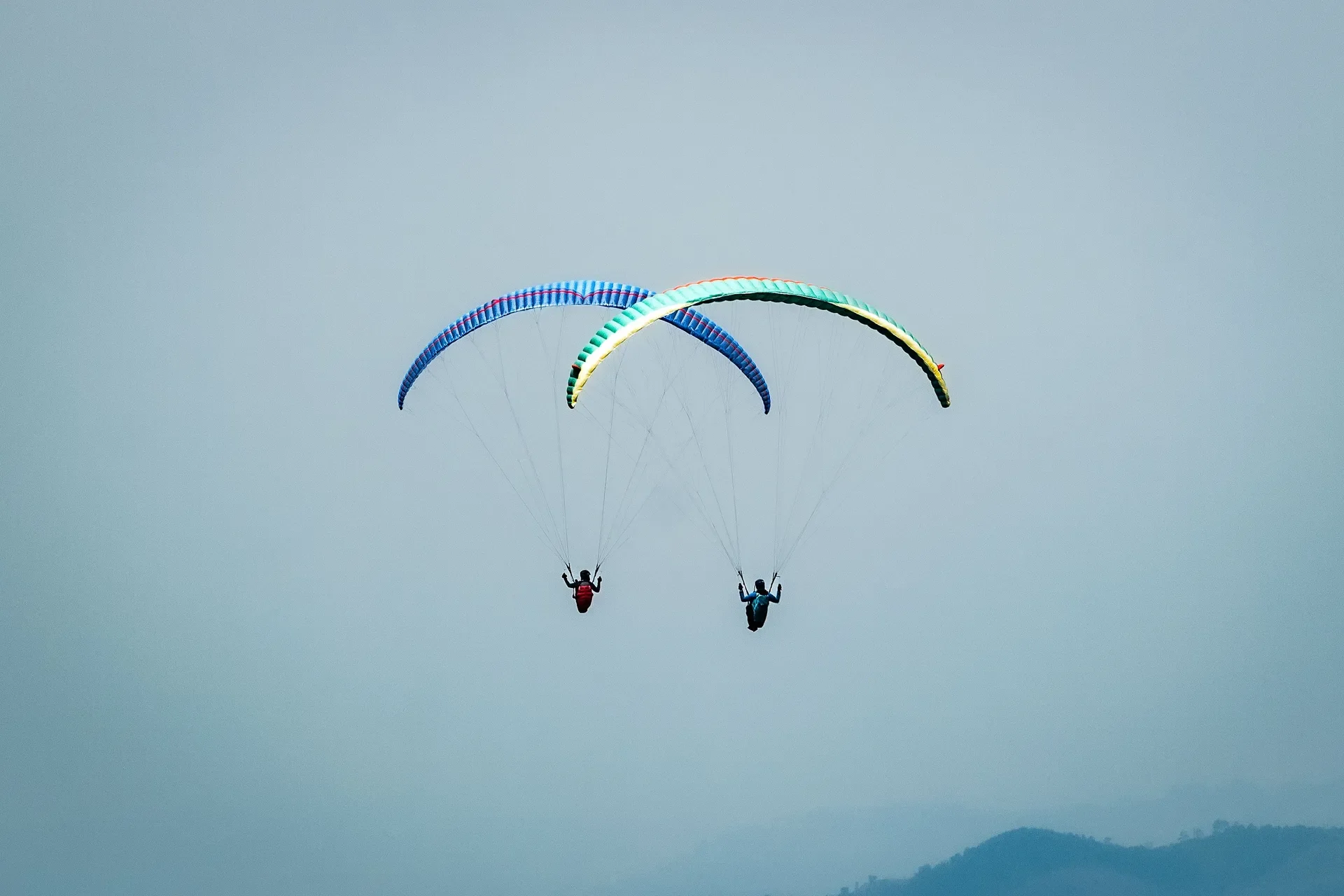
Nearly all Pokhara tandem flights launch from Sarangkot, a ridge at around 1,600 meters above sea level, and land on the shore of Phewa Lake at roughly 800 meters. The drive up takes about 30-40 minutes from lakeside by jeep, included in most packages.
At the launch site you will be fitted into a harness and helmet, then briefed for a minute or two. The takeoff itself is simple: your pilot tells you to walk, then run a few steps down the slope, and the wing inflates and carries you off the edge. There is no jumping involved, and the lift is gentle.
Once airborne, you sit comfortably in the harness, almost like a reclined chair, with the pilot behind you. You will circle in thermals, often joined by Himalayan vultures and eagles riding the same rising air. The descent over the lake before landing is the part most people remember most.
On a clear flight you will look across at Machhapuchhre (Fishtail), Annapurna South, and the wider Annapurna massif, with the Pokhara valley and Phewa Lake laid out below. The combination of a large lake, a foothill ridge, and 7,000-8,000-meter, peaks in one frame is what makes this site world-class.
Tandem paragliding in Pokhara is safe when flown with a licensed, insured pilot on certified equipment. Choose registered operators, confirm pilot certification, and check that the company carries liability and accident insurance. Weather is the primary reason pilots delay or cancel, and a responsible pilot will not fly in marginal conditions.
Pokhara hosts certified international tandem pilots, many with thousands of flights logged. We strongly advise booking through verified operators rather than walk-up touts at the lake, where credentials are harder to confirm. Ask to see the pilot's certification and confirm the reserve parachute is packed and current.
Standard travel insurance often excludes paragliding. Buy a policy that explicitly covers tandem paragliding and emergency helicopter evacuation in Nepal. This is the same advice we give every traveler heading into the mountains, and it is non-negotiable for any adventure activity here.
Most operators set a weight range of roughly 25 kg to 100 kg and accept passengers from children to seniors in reasonable health. If you are pregnant, have heart conditions, or have recent surgeries, consult a doctor first and disclose this to your operator. No flying experience is required for a tandem flight.
Sarangkot mornings are cold even in autumn, so dress in layers. Closed shoes are mandatory for the running takeoff. Here is a quick checklist our team hands to first-time flyers.
Leave loose items behind. Phones, hats, and anything not secured can be lost mid-flight, so let the pilot hold your camera or buy the video package instead.
Pokhara has full mobile coverage. Ncell offers strong service throughout the Annapurna region and lakeside, while Nepal Telecom (NTC) is the more reliable choice if you continue toward remote trekking zones afterward. Buy a SIM at the airport or in lakeside with your passport and a photo. Sarangkot has solid signal, so you can share photos minutes after landing.
Paragliding pairs perfectly with the rest of what Pokhara offers. Many travelers fly in the morning, then spend the afternoon on Phewa Lake boating or exploring lakeside cafes. If you are deciding when to come, our guide to the best time to visit Pokhara lines up neatly with the prime flying windows.
Pokhara is also the gateway to the Annapurna treks. Plenty of our guests fly here as a warm-up before heading out on the Ghorepani Poon Hill trek or the Mardi Himal trek. If trekking is on your list, start with our trek packing list so you are ready when the flight is over.
A standard 20-30 minute tandem flight from Sarangkot generally costs USD 70 to USD 100. Cross-country flights and photo/video packages cost more. Prices shift with season and demand, so confirm live rates through your operator before booking.
The best windows are late September to mid-December and February to April, with clear skies, stable thermals, and the cleanest mountain views. The monsoon from June to August sees frequent weather cancellations.
Yes, when flown with a licensed, insured pilot on certified equipment. Choose registered operators, confirm certification, and verify accident insurance. Pilots cancel or delay flights based on weather, which is the main safety factor.
No. A certified pilot controls the wing while you sit strapped in front. You only run a few steps at takeoff. Most healthy travelers can fly, with weight limits between roughly 25 kg and 100 kg.
A standard tandem flight gives 20 to 30 minutes of airtime. Cross-country and acrobatic flights extend to 45-60 minutes, depending on thermal conditions and your chosen package.
Many operators accept cards and digital wallets, but readers fail and surcharges happen. Carry enough NPR as backup, or pre-book online to lock in your rate.
Get travel ideas and local experiences from My Easy Guide in your inbox.
Spam free. Unsubscribe anytime. We respect your privacy.