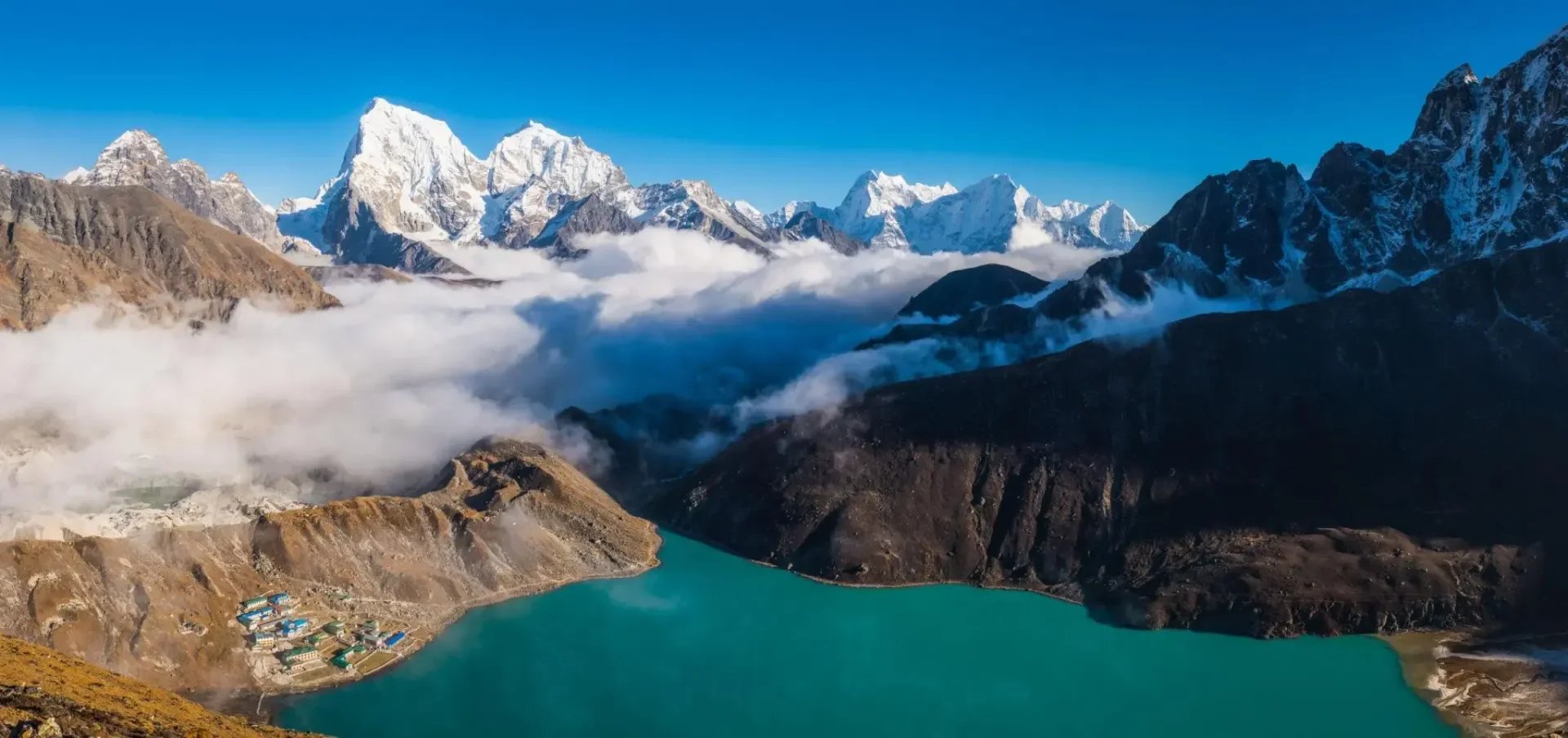
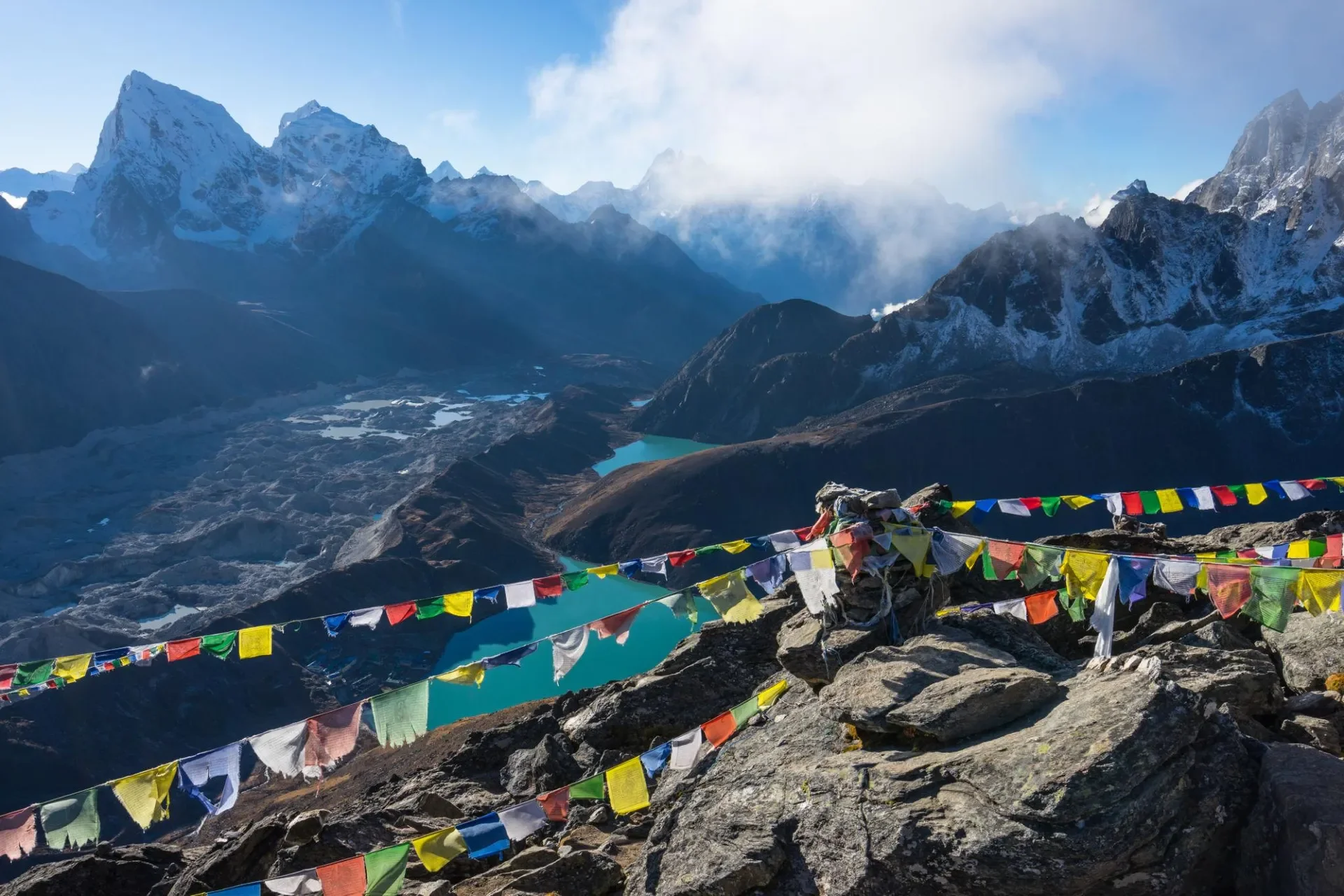
Stand on the rocky summit of Gokyo Ri at dawn and you understand instantly why so many seasoned trekkers quietly prefer this valley to the classic Everest Base Camp route. From a single viewpoint you see four giants over 8,000 meters, Everest, Lhotse, Makalu, and Cho Oyu, stacked across the horizon, with the turquoise Gokyo Lakes glinting below and the largest glacier in the Himalayas grinding past your boots.
Our field coordinators have tracked both routes for years, and the verdict is consistent: EBC gets you close to the mountain, but Gokyo gets you the view. Here is everything you need to plan the Gokyo Lakes Trek for 2026, from permits and altitude safety to the exact reasons the panorama wins.
Why Gokyo Beats Everest Base Camp for Views
Gokyo Ri at 5,357 meters, delivers a panoramic view of four 8,000-meter peaks in a single sweep, Everest, Lhotse, Makalu, and Cho Oyu. At Everest Base Camp itself (5,364 meters), Everest's summit is actually hidden behind Nuptse. Gokyo also offers the sacred lakes and the vast Ngozumpa Glacier, scenery EBC simply lacks.
The honest truth is that arriving at Everest Base Camp is more of an emotional milestone than a scenic one. You stand on rubble at the foot of the Khumbu Icefall, and Everest is not even visible from the spot. The famous summit views on the EBC route come from Kala Patthar, a separate climb.
Gokyo flips this. The whole valley is built around lakes and viewpoints. You walk past a string of glacial pools the color of jade, then climb a single steep ridge for one of the finest mountain panoramas on earth. Fewer crowds, cleaner light, and a payoff that hits the second you crest the ridge.
Permits and 2026 Costs for the Gokyo Trek
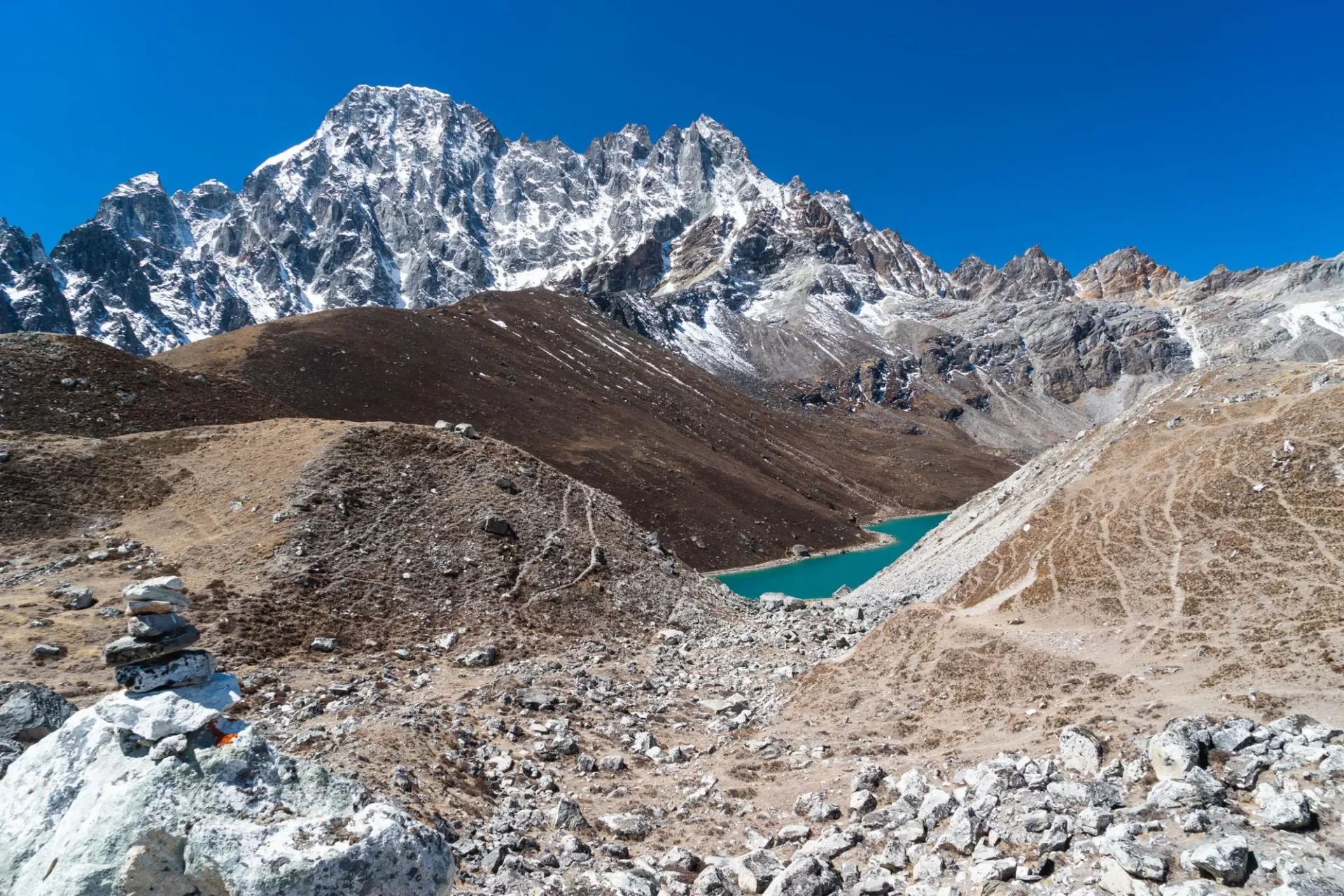
A classic stone cairn marks the rugged trekking route as it winds through rocky terrain toward the alpine lakes of the Everest region.
The Gokyo Lakes Trek requires two permits: the Sagarmatha National Park Permit (NPR 3,000) and the Khumbu Pasang Lhamu Rural Municipality fee (NPR 3,000). The Everest region does not use the standard e-TIMS card. You buy the municipality fee in Lukla or Monjo, and the park permit at Monjo checkpoint.
Budget around NPR 6,000 total for entry permits. Carry the cash in Nepalese Rupees, as checkpoints do not take cards. Keep both permits accessible; rangers check them at multiple points along the trail.
A little inspiration for your next trip
Get travel ideas and local experiences from My Easy Guide in your inbox.
Spam free. Unsubscribe anytime. We respect your privacy.
Permit / Fee
2026 Cost
Where to Buy
Sagarmatha National Park Permit
NPR 3,000
Monjo checkpoint
Khumbu Pasang Lhamu Municipality Fee
NPR 3,000
Lukla / Monjo
Nepal Tourist Visa (30 days)
$50 USD
Kathmandu Airport on arrival
For the visa: $30 USD covers 15 days, $50 USD covers 30 days, and $125 USD covers 90 days. A 30-day visa is plenty for this trek. For a deeper breakdown of regional fees, see our guide to trekking rules and costs.
Getting to Lukla: The Ramechhap Reality
Most Gokyo treks start with a flight to Lukla's Tenzing-Hillary Airport. During peak seasons (March–May and September–November), Lukla flights do not depart from Kathmandu. They operate from Manthali Airport in Ramechhap, requiring a 4–5 hour overnight drive from Kathmandu, usually departing around 1:00 AM.
This catches many trekkers off guard. You leave the city in the dark, drive through the hills, and catch a short morning flight when the weather window is clearest. Outside peak season, flights run directly from Kathmandu.
Mountain weather grounds these flights regularly. Always build 1–2 buffer days into your itinerary for delays. We never recommend booking an international departure flight for the day after your trek ends. Flight prices are volatile, so verify live rates through your agency or our marketplace before booking. Read more in our Lukla Airport guide.
Gokyo Lakes Trek Itinerary (Day by Day)
A safe Gokyo Lakes Trek runs roughly 12–13 days round trip from Kathmandu. The route branches off the main Everest trail at Namche Bazaar, heading northwest up the Dudh Koshi valley toward Dole, Machhermo, and Gokyo. Acclimatization rest days are mandatory, not optional.
Above 3,000 meters, your sleeping elevation should not rise by more than 300–500 meters per day, with proper rest days built in. The itinerary below respects that rule.
Day
Route
Elevation
Walk Time
1
Fly to Lukla, trek to Phakding
2,610 m
3–4 hrs
2
Phakding to Namche Bazaar
3,440 m
5–6 hrs
3
Namche — acclimatization rest day
3,440 m
Day hike
4
Namche to Dole
4,038 m
5–6 hrs
5
Dole to Machhermo
4,470 m
4–5 hrs
6
Machhermo to Gokyo village
4,790 m
4–5 hrs
7
Gokyo Ri summit + rest day
5,357 m
3–4 hrs
8
Gokyo to Dole
4,038 m
5–6 hrs
9
Dole to Namche
3,440 m
5–6 hrs
10
Namche to Lukla
2,860 m
6–7 hrs
11
Fly Lukla to Kathmandu
1,400 m
Flight
The acclimatization day at Namche is non-negotiable. Use it to hike up toward the Everest View Hotel, then sleep low. Fit trekkers can extend this loop by crossing the Cho La Pass (5,420 m) to join the EBC trail near Dzongla, a glacier crossing that demands experience and good weather.
The Gokyo Lakes and Ngozumpa Glacier
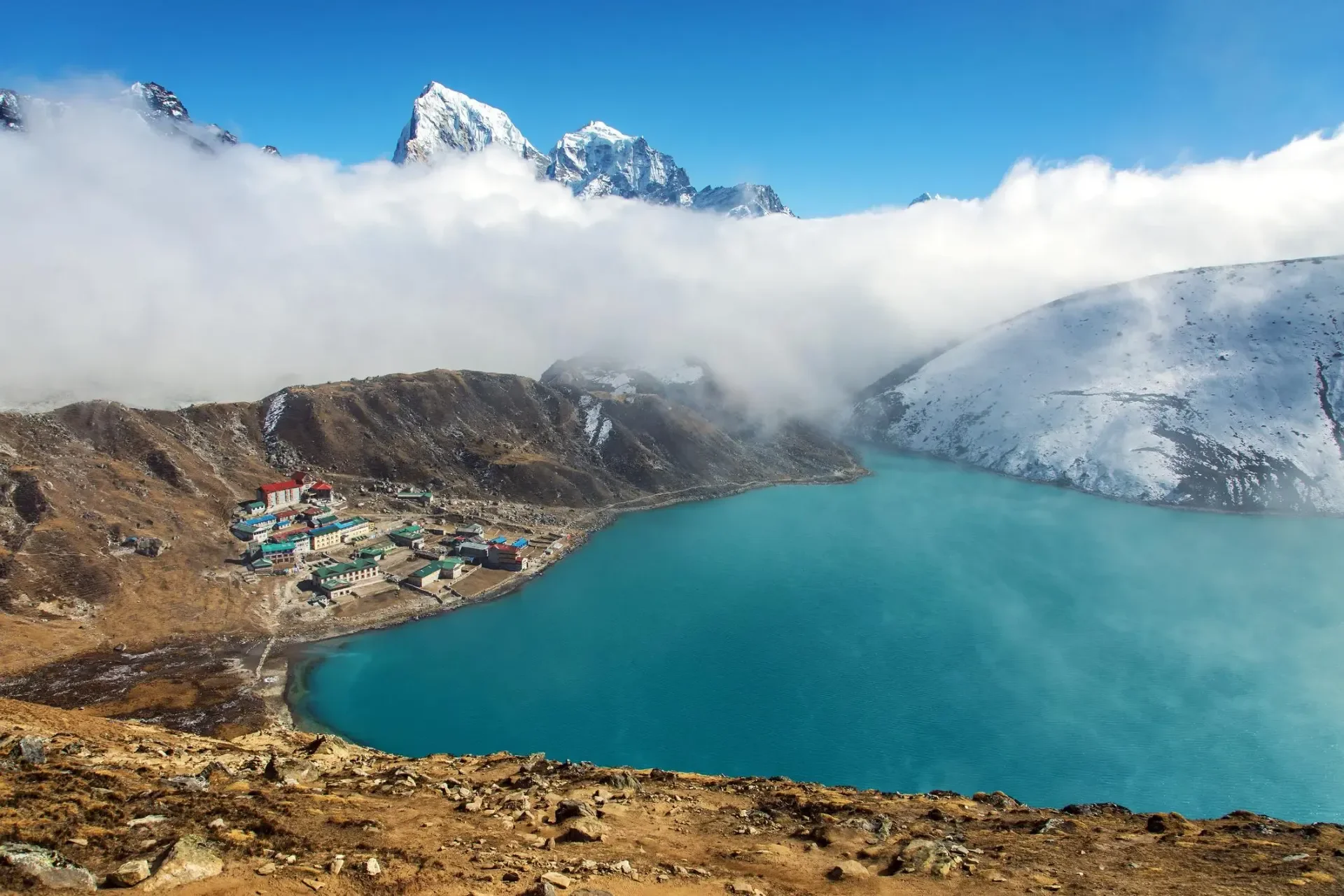
A scenic morning view of Gokyo village resting along the shore of the vibrant turquoise Third Lake, framed by rolling mist and high Himalayan peaks.
The Gokyo Lakes are a chain of six glacial lakes, the world's highest freshwater lake system, fed by the Ngozumpa Glacier. The third lake, Dudh Pokhari, sits beside Gokyo village at 4,790 meters. The Ngozumpa is the longest glacier in the Himalayas, stretching roughly 36 kilometers (22 miles).
These lakes are sacred to both Hindus and Buddhists. Locals consider them holy, so do not swim, wash, or throw anything into the water. Walk the shoreline quietly and respect the prayer flags strung along the banks.
Strong trekkers often push beyond the third lake to the fourth and fifth lakes, where a viewpoint called Scoundrel's Viewpoint frames Everest and Cho Oyu reflected in still water. It is one of the most underrated spots in the entire Khumbu.
Altitude Safety and Helicopter Insurance
Acute Mountain Sickness is the real risk on this trek, not the terrain. Follow the rule of climbing high and sleeping low, take your rest days, and descend immediately if symptoms of HAPE or HACE appear. Never ascend with a headache that worsens.
Standard travel insurance is not enough. You must carry a policy that specifically covers high-altitude emergency helicopter evacuation up to 6,000 meters and medical treatment for AMS, HAPE, and HACE. Verify the wording before you fly.
For a complete walk-through of acclimatization and rescue logistics, see our piece on high-altitude trekking logistics.
Food, Water, and Trail Cash
Stick to vegetarian meals in the Khumbu. Slaughtering animals is prohibited by local Buddhist law here, so all meat is carried up by mule or porter over several days without refrigeration. The safest, highest-energy choice is Dal Bhat, lentil soup, rice, and vegetable curry, usually with free refills.
Skip bottled water entirely to protect the valley. Carry a reusable bottle paired with a Sawyer squeeze filter, UV purifier, or chlorine dioxide drops. Teahouses sell boiled water, but purifying yourself is cheaper and greener.
There are no ATMs past Namche Bazaar. Carry enough Nepalese Rupees cash for the whole trek. Expect extra charges that are rarely included in your room: charging a phone or power bank, gas-heated hot showers, and Everest Link Wi-Fi each typically cost 200 to 700 NPR per use.
For connectivity, Nepal Telecom (NTC) is essential in the Gokyo Valley and across the Everest region. Buy a SIM in Kathmandu and load data before you leave.
Sacred Etiquette on the Trail
Colorful Tibetan prayer flags flutter at the summit of Gokyo Ri, offering a sweeping bird's-eye view of the massive Ngozumba Glacier and the lakes beneath.
The Khumbu is deeply Buddhist, and small gestures matter. Always pass mani stones, chortens, and stupas on the left, keeping the structure to your right, and walk clockwise around them. This respects centuries of local tradition.
Remove your shoes and hat before entering any monastery or temple. Outdoor photography is fine, but photographing inside monastery prayer halls is strictly prohibited unless a resident monk gives you explicit permission.
At the end of your trek, tipping your crew is culturally expected and a vital part of their income. A standard guideline is 15% to 20% of your total trek cost, distributed fairly among guides and porters.
Best Time to Trek Gokyo Lakes
The two prime windows are autumn (September–November) for crisp, stable skies and spring (March–May) for rhododendron blooms and warmer days. Both seasons trigger the Ramechhap flight diversion, so plan accordingly.
Winter (December–February) brings empty trails and brutal cold, with the Cho La Pass often impassable. The monsoon (June–August) drenches the Khumbu in cloud and leeches, if you want summer trekking, the rain-shadow valleys of Upper Mustang and Upper Dolpo are far better choices than Gokyo.
You need layered clothing rated for temperatures well below freezing at Gokyo, sturdy broken-in boots, a four-season sleeping bag, and reliable sun protection for the high-altitude glare off the snow and lakes.
Down jacket rated to at least -15°C
Thermal base layers and fleece mid-layers
Waterproof shell jacket and trousers
UV-protection sunglasses (category 4) and high-SPF sunscreen
Water purification system and a reusable bottle
Headlamp with spare batteries for the dark Lukla flight
Sufficient NPR cash and a small first-aid kit with Diamox
Is the Gokyo Lakes Trek harder than Everest Base Camp?
It is roughly similar in difficulty, but quieter. The steep climb up Gokyo Ri at 5,357 meters is the main test. Adding the Cho La Pass raises difficulty considerably.
Do I need a guide for the Gokyo Lakes Trek in 2026?
Nepal strongly enforces licensed guide requirements across major regions in 2026. Verify the current rules and trek with a licensed guide for safety and altitude management.
What permits do I need?
The Sagarmatha National Park Permit (NPR 3,000) and the Khumbu Pasang Lhamu Municipality fee (NPR 3,000). No e-TIMS card is used in the Everest region.
Is there Wi-Fi at Gokyo?
Yes, via Everest Link cards or paid lodge access, usually 200 to 700 NPR. NTC mobile coverage is the most reliable.
How high is Gokyo Ri?
The summit is 5,357 meters, with views of four 8,000-meter peaks and the Ngozumpa Glacier.
Can I combine Gokyo and EBC?
Yes, via the Cho La Pass (5,420 m). This loop needs extra days, glacier experience, and stable weather.