Sandeep Shrestha
Both of these iconic routes end at a place called "Base Camp," and that single shared word causes more poor booking decisions than any other factor. When weighing the Annapurna vs Everest Base Camp trek, many travelers assume the experiences are interchangeable. They aren’t. One route tops out at 4,130m and is accessible by road. The other climbs to a grueling 5,545m at Kala Patthar and depends on Lukla, one of the most weather-volatile mountain airstrips on Earth.
Every trekking season, the same crucial question arises: which one should I do? The honest answer depends on your altitude tolerance, budget, schedule, and appetite for logistical friction. This comparison lays out exactly where the two diverge so you can choose with open eyes.

The Annapurna Base Camp (ABC) trek climbs through terraced farmland, rhododendron forest and the dramatic glacial amphitheatre of the Annapurna Sanctuary. It is shorter, lower and far easier to reach from Pokhara.
The Everest Base Camp (EBC) trek follows the historic Khumbu corridor past Sherpa monasteries to the foot of the world's highest mountain. It is higher, longer, colder and tied to the Lukla flight, which shapes the entire itinerary.
Neither is a Restricted Area trek, so single travelers can join either. Both still benefit enormously from a licensed guide, and is mandatory.
The ultimate guide to planning your dream web travel adventure with the experts from myeasyguide.
Spam free. Unsubscribe anytime. We respect your privacy.
Each region uses a different permit stack, and the Everest region does not use the standard TIMS card. Carry printed copies and keep cash ready at checkpoints.
You will also need a Nepal tourist visa: USD 30 for 15 days, USD 50 for 30 days, or USD 125 for 90 days, available on arrival at Tribhuvan International Airport.
Neither trek requires a Restricted Area Permit, so solo permit issuance is fine. We still recommend a licensed guide for both because licensed guides are mandatory as per the new rules.
Both treks share the same two prime windows. Spring (March to May) brings rhododendron bloom and warming temperatures. Autumn (October to November) delivers the clearest skies and most stable weather of the year.
Both routes sit south of the main Himalayan range, so neither benefits from the monsoon rain-shadow window. For June through August, monsoon avoidance applies to both. If you want a summer-friendly trek, look instead at the Upper Mustang trek in the rain shadow.

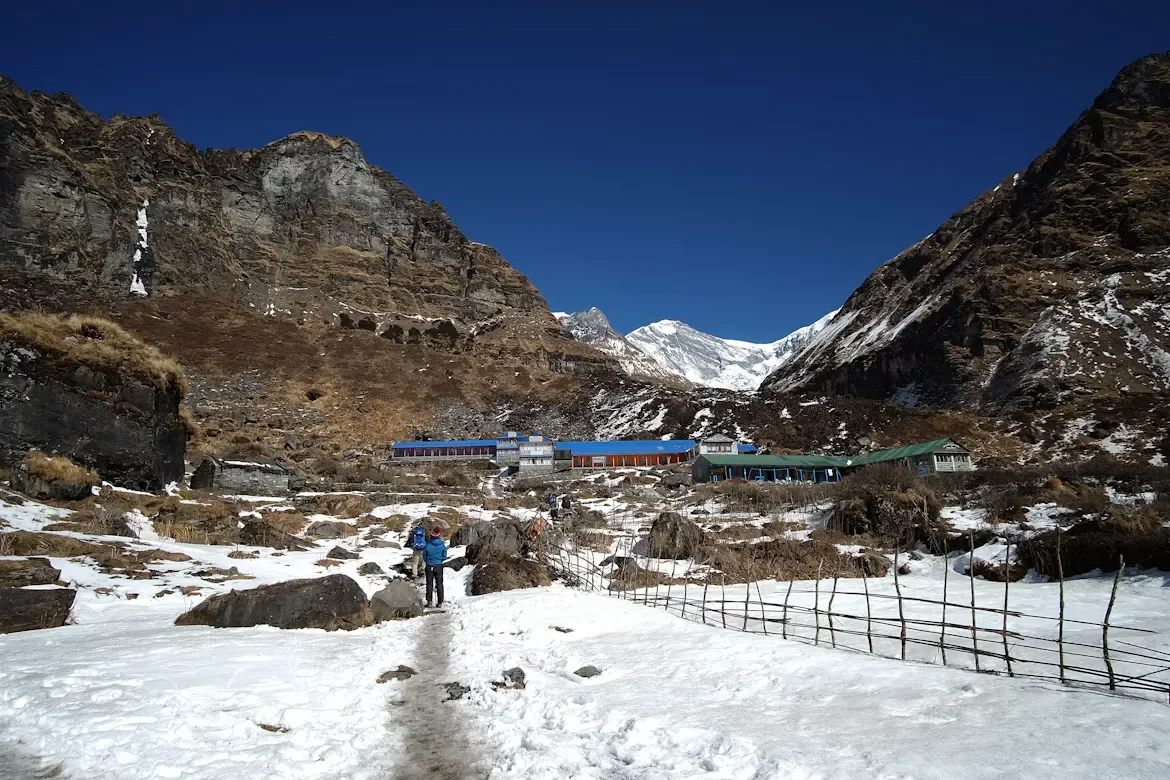
The ABC trail leaves from road-accessible trailheads near Pokhara, climbing through Ghandruk and Chhomrong before the steep stone-stepped corridor to Machhapuchhre Base Camp and finally Annapurna Base Camp (4,130m). The glacial bowl of peaks surrounding the camp is the payoff.
Be aware that jeep roads now reach parts of the lower Annapurna trails. Ask your guide about NATT (Nepal Alternative Trekking Trails) routing to bypass dusty road sections and keep the walking on real trail.

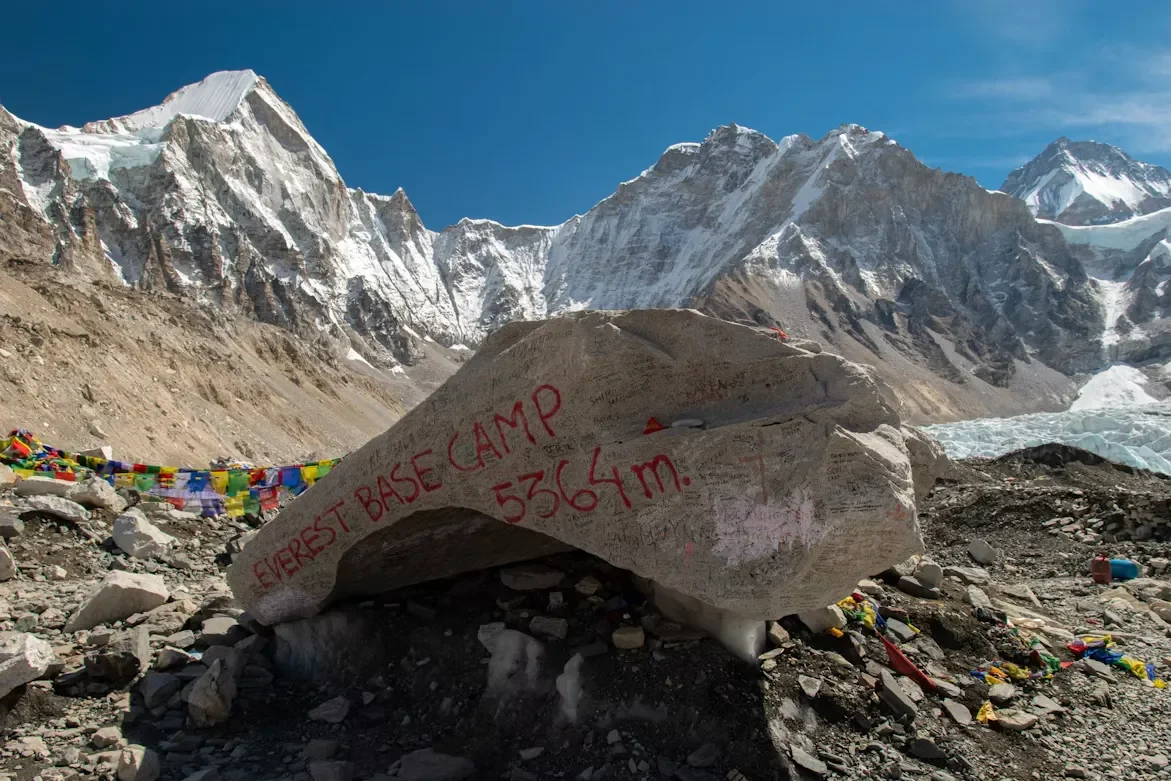
The EBC trail begins after the flight to Lukla, threading the Dudh Koshi valley through Phakding and up to Namche Bazaar (3,440m). From there it passes Tengboche, Dingboche and Lobuche before reaching Gorak Shep, the launch point for both Everest Base Camp (5,364m) and the Kala Patthar viewpoint at 5,545m.
During peak season (March to May and October to November), Lukla flights depart from Manthali Airport in Ramechhap, not Kathmandu. The drive runs roughly 4 to 5 hours, with departures around 1:00 AM. Build 1 to 2 buffer days into each end for weather delays.
We rate Annapurna Base Camp as Grade 2 to Grade 3 (Moderate to Strenuous). The relentless stone staircases test the legs, but the lower maximum elevation keeps altitude risk manageable.
We rate Everest Base Camp as Grade 3 (Strenuous). The distances are not technical, but the combination of high altitude, long days above 5,000m and cold raises the demand considerably.
Above 3,000m, sleep elevation should not rise more than 300 to 500m per day. EBC enforces this hard, with a mandatory acclimatization day at Namche Bazaar (3,440m) and a second rest stage around Dingboche. ABC's lower ceiling makes its profile gentler, but the rule still applies on the upper approach.
Watch for AMS warning signs: persistent headache, nausea, loss of coordination, breathlessness at rest, or bluish lips. Descent is the only reliable treatment for severe AMS. Do not wait for morning. Do not treat medication as a substitute for descent.
The Himalayan Rescue Association (HRA) Clinic at Pheriche (approx. 4,371m) serves the Everest region, and the HRA Clinic at Manang serves the wider Annapurna region. For post-trek follow-up, CIWEC Hospital, Kathmandu is our recommendation.
Carry insurance covering helicopter evacuation to at least 6,000m plus AMS, HAPE and HACE treatment. Standard travel insurance is insufficient. Evacuation operators include Fishtail Air, Simrik Air and Karnali Air, always coordinated through your guide.
EBC demands heavier cold-weather layering because of altitude and dawn starts at Gorak Shep. ABC needs less extreme insulation but the same wet-weather discipline. Both require a reusable water system.
See our full trek packing list before you finalize your kit.
The single biggest cost gap is the Lukla flight. ABC's road access from Pokhara removes that expense entirely, which is why ABC consistently comes in cheaper.
Flight, jeep, guide and lodge prices shift with season and operator, so verify live rates before booking. Compare our detailed Annapurna Base Camp trek cost and Everest Base Camp trek cost breakdowns. Ready to lock in dates? Talk to our team to match you with a licensed guide and confirmed permits.
For the Annapurna region, an Ncell SIM gives strong coverage; buy it in Pokhara. For the Everest region, Nepal Telecom (NTC) is the better choice, as Ncell degrades sharply above Namche Bazaar. Everest Link Wi-Fi runs roughly NPR 400–700 per session.
ATMs stop at Namche Bazaar in the Khumbu, so carry enough NPR cash before that point. Expect upcharges of NPR 200–500 for charging and NPR 300–600 for hot showers. Download offline maps before you go.
On both routes, choose vegetarian. In the Buddhist Khumbu, animal slaughter is prohibited and meat is carried in unrefrigerated over days. Dal Bhat is the nutritionally complete trail standard, usually with free refills.
If you hire crew, hold porter loads to 20 to 25 kg and tip 15 to 20% of the trek cost, shared across the team.
Pass mani stones, chortens and stupas on the LEFT, keeping the structure to your right, and walk clockwise around them. Remove shoes and hats before entering any monastery.
Photography inside prayer halls is prohibited unless a monk grants permission. Always ask before photographing local residents, and do not hand sweets or money to children, support a registered school or organization instead.
First-timer: Choose Annapurna Base Camp. Lower altitude, shorter duration, road access and lower cost make it the safer introduction to Himalayan trekking.
Experienced trekker: Choose Everest Base Camp. The higher ceiling, the Khumbu monasteries and the Kala Patthar sunrise reward those comfortable with sustained altitude. For a step up, see the Three Passes versus EBC comparison.
Budget traveler: Choose Annapurna Base Camp. Skipping the Lukla flight is the single largest saving available on a Nepal teahouse trek.
Premium traveler with limited time: Consider EBC with a helicopter transfer from Kathmandu to Lukla, which bypasses the Ramechhap pre-dawn drive entirely.
Yes. EBC reaches 5,545m at Kala Patthar with high altitude risk, while ABC tops out at 4,130m. EBC is Grade 3; ABC ranges Grade 2 to Grade 3.
ABC, because it avoids the Lukla flight and carries lower altitude lodge prices.
Neither is a Restricted Area, but a licensed guide is strongly advised for both and effectively required in the Annapurna Conservation Area.
ABC runs 7 to 11 days; EBC runs 12 to 14 days plus buffer days for Lukla weather.
Both sit south of the main range, so June through August brings rain, leeches and poor visibility. We advise against both in that window.
Annapurna Base Camp, for its lower altitude, easier access and gentler logistics.