Asmita Karki
The Langtang Valley remains the best-value Himalayan trek you can do within easy reach of Kathmandu. You skip the expensive Lukla flight entirely, drive north through terraced hills, and walk into a glacier-carved valley that was rebuilt by its Tamang and Tibetan-descended communities after the 2015 earthquake. The result is a trek that costs a fraction of Everest or the longer restricted routes, yet still delivers high mountains, yak pastures, and warm teahouse stoves.
Below we break down every rupee, from permits to porters, so you can decide whether to go solo and lean, or hire a guide and travel with support. All figures reflect 2026 rates verified against Langtang National Park and Nepal Tourism Board frameworks.

A solo budget Langtang trek costs roughly USD 350 to USD 550 for a standard 7 to 8-day itinerary, covering permits, local bus transport, food, and basic lodging. A fully guided package with a licensed guide, private or shared transport, and full board typically runs USD 600 to USD 1,100, depending on group size and the quality of service.
Langtang is genuinely affordable because it has no mandatory restricted-area guide rule and no costly domestic flight. Your two biggest variables are whether you hire a guide and how you handle transport from Kathmandu to Syabrubesi.
The Langtang Valley trek requires two documents: the Langtang National Park entry permit and the TIMS card. There is no Restricted Area Permit (RAP) here, which keeps permit costs low. However, per the Nepal Tourism Board's TIMS provision, Langtang routes require both the TIMS card and a licensed trekking guide, unguided solo trekking is not permitted.
Here are the exact fixed government fees for 2026:
The ultimate guide to planning your dream web travel adventure with the experts from myeasyguide.
Spam free. Unsubscribe anytime. We respect your privacy.
Add Nepal's 13% VAT on the National Park permit at the entry counter or in Kathmandu. You can arrange both documents at the Nepal Tourism Board office in Kathmandu, or the National Park permit at the Dhunche checkpoint. We recommend getting them in Kathmandu to avoid morning queues. Read our full TIMS card guide for the latest issuance process.
Your Nepal tourist visa on arrival is separate from trek costs. The 2026 rates are $30 USD for 15 days, $50 USD for 30 days, and $125 USD for 90 days. A 15-day visa comfortably covers a standard Langtang itinerary, but if you plan to add side trips, the 30-day option gives you breathing room.

Transport is the single most negotiable line item on a Langtang budget. The trailhead at Syabrubesi (1,550 meters) sits about 7 to 8 hours by road from Kathmandu along a winding, sometimes rough mountain highway.
You have three realistic options:
These transport figures move with fuel prices and season, so treat them as a guide and confirm live rates at the New Bus Park (Machhapokhari) in Kathmandu or through your operator. We always recommend leaving Kathmandu early, ideally before 7:00 AM, to reach Syabrubesi before dark.
Once you start walking, your daily spend is predictable. Teahouse rooms are cheap because lodges make their money on meals. Expect a twin room to cost NPR 300 to NPR 800 per night, and in some lodges it is free if you eat dinner and breakfast there.
Food is where your daily budget lands. As you climb toward Kyanjin Gompa (3,870 meters), prices rise because everything is carried up by foot or mule.
Plan for roughly NPR 2,500 to NPR 4,000 per day for food and lodging combined. We strongly recommend the classic Dal Bhat: lentil soup, rice, and vegetable curry. It comes with free refills, fuels long climbs, and is made fresh daily. Learn more about teahouse food on Nepal treks before you go.
Budget travelers often forget the small extras that add up fast. Charging your phone or power bank, taking a gas-heated hot shower, and using Wi-Fi are rarely included in your room rate. Each of these typically costs 200 to 700 NPR per use. Over a week, that can quietly add NPR 3,000 to NPR 5,000 to your bill, so factor it in.

As of February 2025, Langtang National Park requires all trekkers, foreign and Nepali, solo or group, to hire a licensed guide through a registered trekking agency. Unguided trekking is no longer permitted. Since a guide is now mandatory, the real budget question is lean guided vs. full-service guided, not solo
Going lean means handling your own food/lodging choices on the trail and possibly sharing a guide across a small group to bring the per-person cost down. The full-service route costs more but includes private transport, full board, and a guide arranged entirely by your agency. For solo travelers, especially first-timers, our solo female trekking guide covers practical safety considerations on routes like this.
If you hire a guide or porter, tipping is culturally expected and forms a vital part of their income. Budget 10% to 15% of your total trek cost, distributed fairly among the crew at the end of the trip. For a porter on a 7-day trek, a tip of NPR 5,000 to NPR 8,000 is a respectful baseline.

The Langtang trek climbs steadily from Syabrubesi to Kyanjin Gompa. The valley is moderate by Himalayan standards, but you still pass 3,000 meters, so altitude rules apply. Above 3,000 meters, never increase your sleeping elevation by more than 300 to 500 meters per day, and take a rest day to acclimatize.
The Day 5 acclimatization hike to Kyanjin Ri (4,773 meters) or Tserko Ri (4,984 meters) is the highlight, with a full panorama of Langtang Lirung. You climb high during the day and return to sleep at the lower Kyanjin elevation. If you feel symptoms of altitude sickness, descend. Read our detailed guides on altitude sickness and Diamox use on treks.
Standard travel insurance is not enough for the Himalaya. You need a policy that explicitly covers high-altitude emergency helicopter evacuation up to 6,000 meters and medical treatment for AMS, HAPE, and HACE. Budget around $80 to $150 USD for a comprehensive trekking policy. A helicopter rescue from the Langtang Valley can cost thousands of dollars out of pocket without it.
There are no reliable ATMs past Syabrubesi, so carry all your Nepalese Rupees in cash before you leave Kathmandu. For mobile coverage, Nepal Telecom (NTC) tends to perform better than Ncell in the upper Langtang Valley, though signal is patchy above Langtang Village. A local SIM with a data pack costs only a few hundred rupees and is worth picking up at the airport or in Thamel.
You can trek Langtang cheaply without compromising safety. Take the local bus, eat Dal Bhat with free refills, skip paid hot showers in favor of the lower-altitude options, and carry a reusable bottle with a UV purifier or chlorine dioxide drops rather than buying plastic bottled water. Refilling your own water also protects the valley's fragile environment.
Sharing a private jeep and a guide across a small group is the smartest way to balance cost and comfort. Four trekkers splitting a guide and jeep often pay only slightly more per person than going fully solo, while gaining real support.
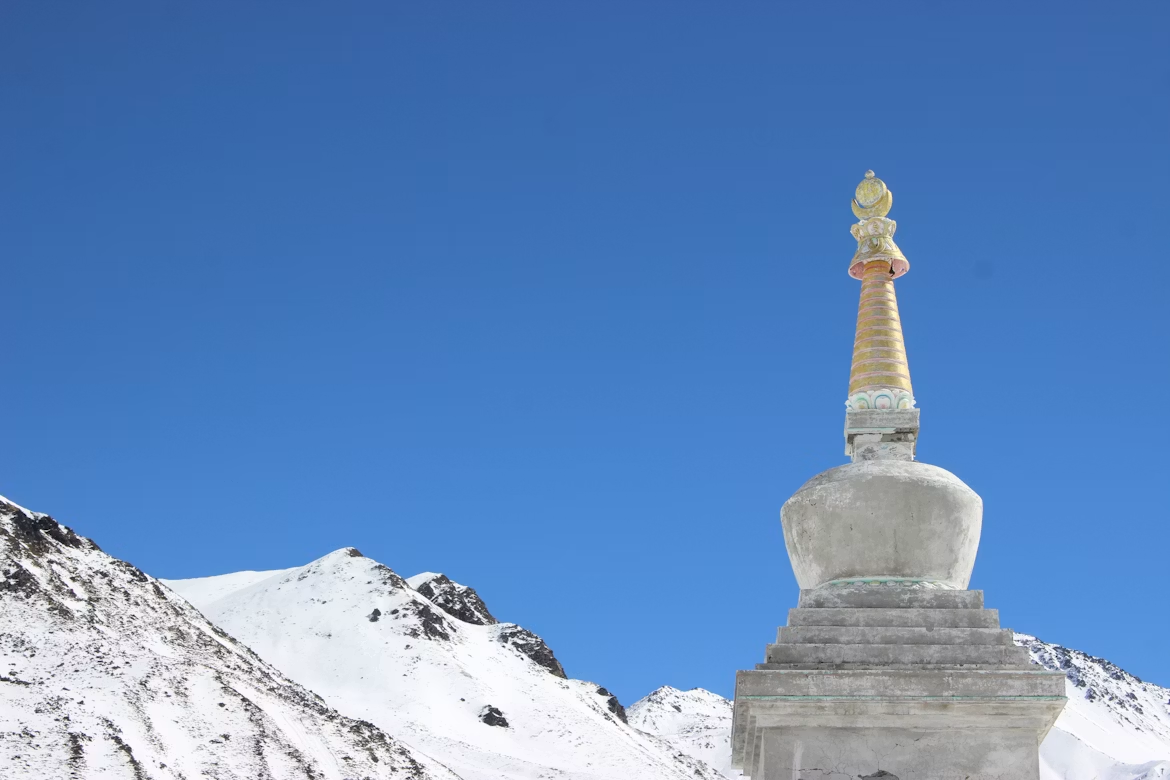
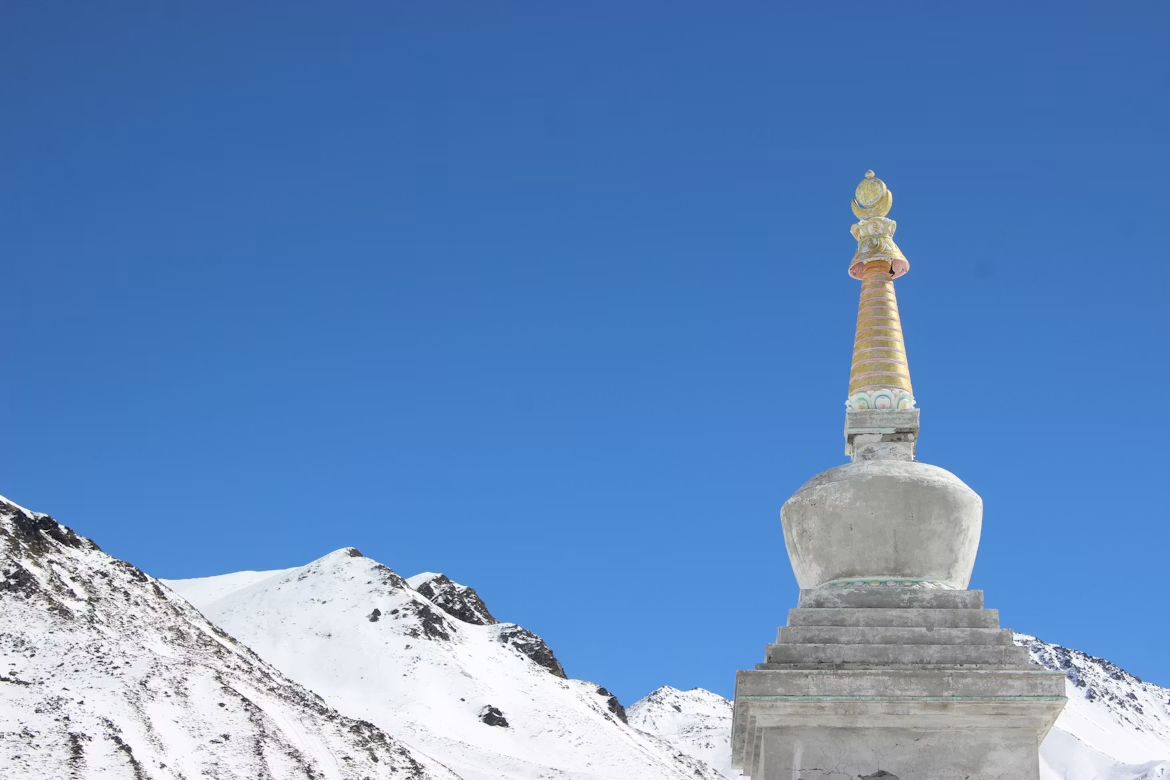
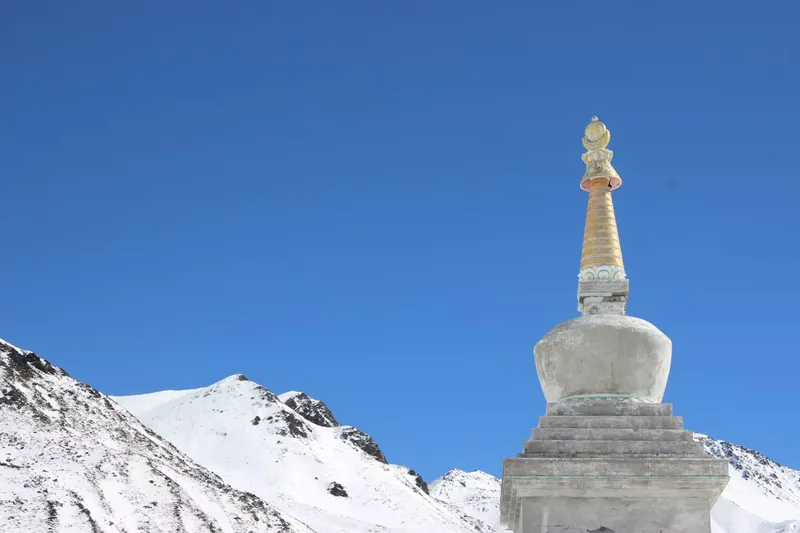
Langtang's villages are deeply Buddhist. Always walk clockwise around mani walls, stupas, and chortens, keeping these sacred structures on your right. Remove your shoes and hat before entering any monastery, and never photograph inside prayer halls unless a resident monk gives you clear permission. These small gestures mean a great deal to the communities that rebuilt this valley.
Yes. It delivers high-mountain scenery, glaciers, and authentic Tamang culture at roughly half the cost of Everest, with no expensive flight required.
No, you cannot legally trek Langtang solo as of 2025–2026. A licensed guide from a registered agency is now mandatory for everyone.
A standard itinerary takes 7 to 8 days including transport, with one acclimatization day at Kyanjin Gompa.
Join or form a small group to share a guide's daily fee, take the local bus instead of a private jeep, eat Dal Bhat, and avoid paid trail extras. This brings the total to around USD 450 to USD 550 per person.
No. Teahouses are cash only. Carry sufficient Nepalese Rupees from Kathmandu, as ATMs do not exist past Syabrubesi.
Some lodges offer paid Wi-Fi for 200 to 500 NPR, but it is slow. NTC mobile data is more reliable in the lower valley.
Plan for NPR 2,500 to NPR 4,000 per day for food and lodging, plus extras for charging, showers, and Wi-Fi.
The Langtang National Park entry permit (NPR 3,000) and a TIMS card (NPR 2,000 for individuals). No Restricted Area Permit is needed, but a licensed guide is mandatory to obtain TIMS and to trek here at all.
Yes. The valley and its trails have been fully rebuilt, with new lodges and stable trails throughout.
Spring (March to May) and autumn (September to November) offer the clearest skies and most stable weather