Picture standing on a wooden platform at 3,210 meters in the dark, breath fogging in the cold, surrounded by a few dozen headlamps. Then the sky behind Dhaulagiri turns from grey to pale gold, and the whole Annapurna massif lights up one peak at a time. That is the Poon Hill sunrise, and we have sent thousands of travelers up that staircase. Here is the honest picture for 2026.
What Time Is the Poon Hill Sunrise in 2026?
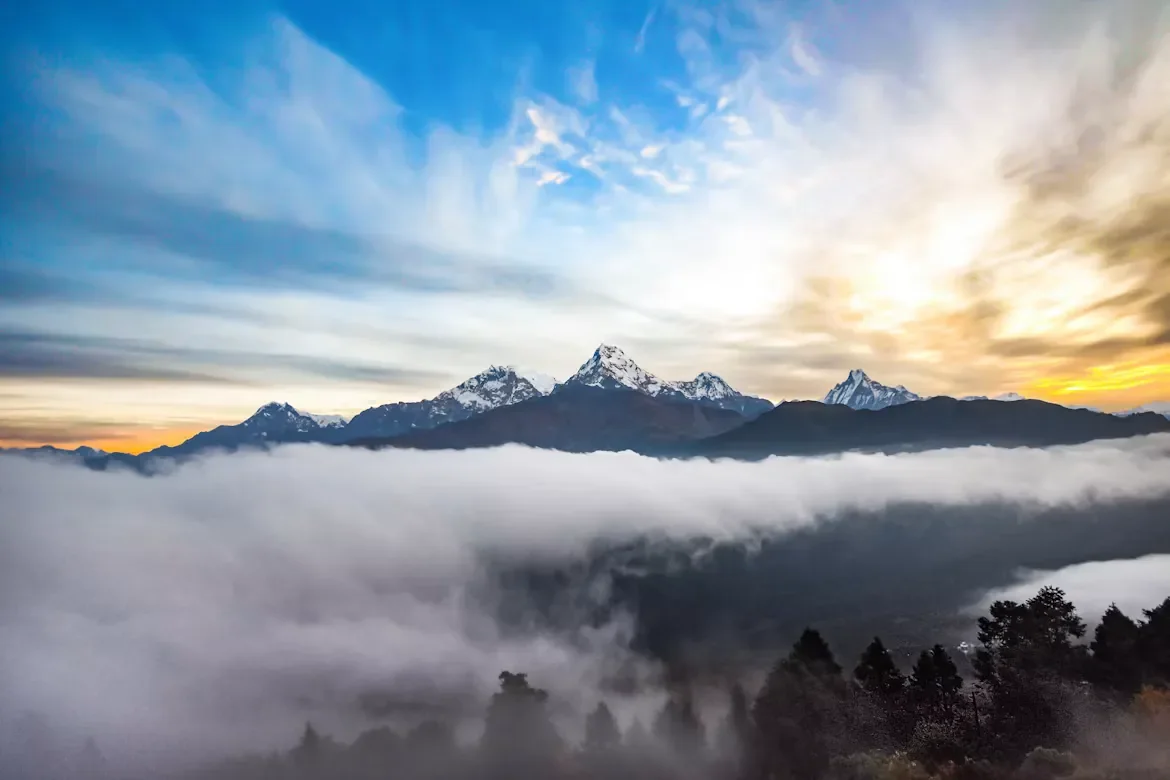
Source: Azin Javadazadeh / Unsplash, A breathtaking morning view from Poon Hill, where the rising sun illuminates the Annapurna massif above a blanket of low valley fog.
Sunrise from Poon Hill in 2026 occurs roughly between 6:00 AM and 6:45 AM depending on the season, with the alpenglow on the peaks starting 15 to 20 minutes earlier. You should leave Ghorepani by 4:30 AM to complete the 45 to 60 minute climb and claim a good spot.
In the autumn months of October and November, first light hits the high peaks around 6:10 AM. In late winter and spring, sunrise drifts later, closer to 6:30 to 6:45 AM. The mountains glow before the sun clears the horizon, so do not judge timing by the sun itself.
Bring a headlamp, gloves, and a warm layer. The summit is windy and cold before dawn, often near freezing even when Ghorepani feels mild.
The Climb: What Actually Happens at 4:30 AM
The climb from Ghorepani village to Poon Hill is a relentless stone staircase gaining around 350 meters over roughly 1.5 kilometers. It takes most fit trekkers 45 to 60 minutes at a steady pace. There is a small ticket checkpoint near the base charging a local NPR 100 entry fee.
You will share the trail with a long line of headlamps in peak season. Pace yourself, breathe steadily, and do not race. The cold air and incline can leave you gasping if you sprint.
At the top there is a viewing tower, a couple of tea kiosks selling hot drinks, and open platforms. Buy a hot lemon or masala tea and settle in to watch the light arrive.
Best Month for the Poon Hill Sunrise
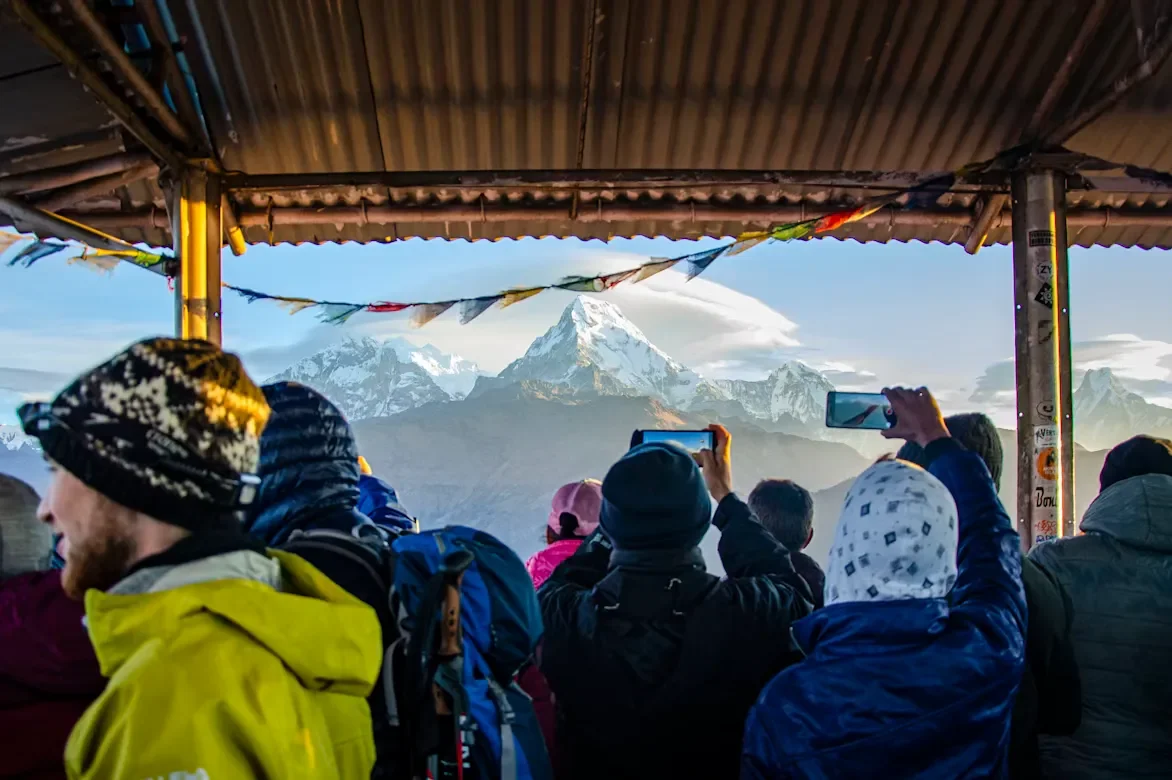
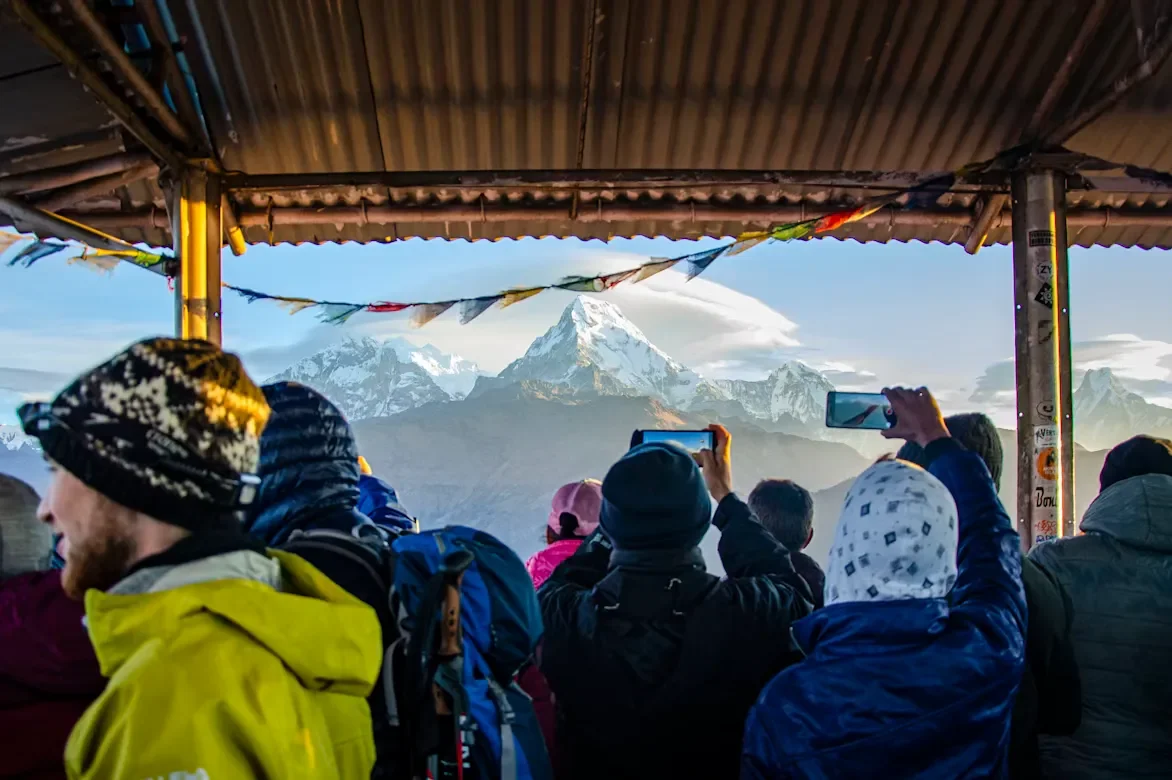
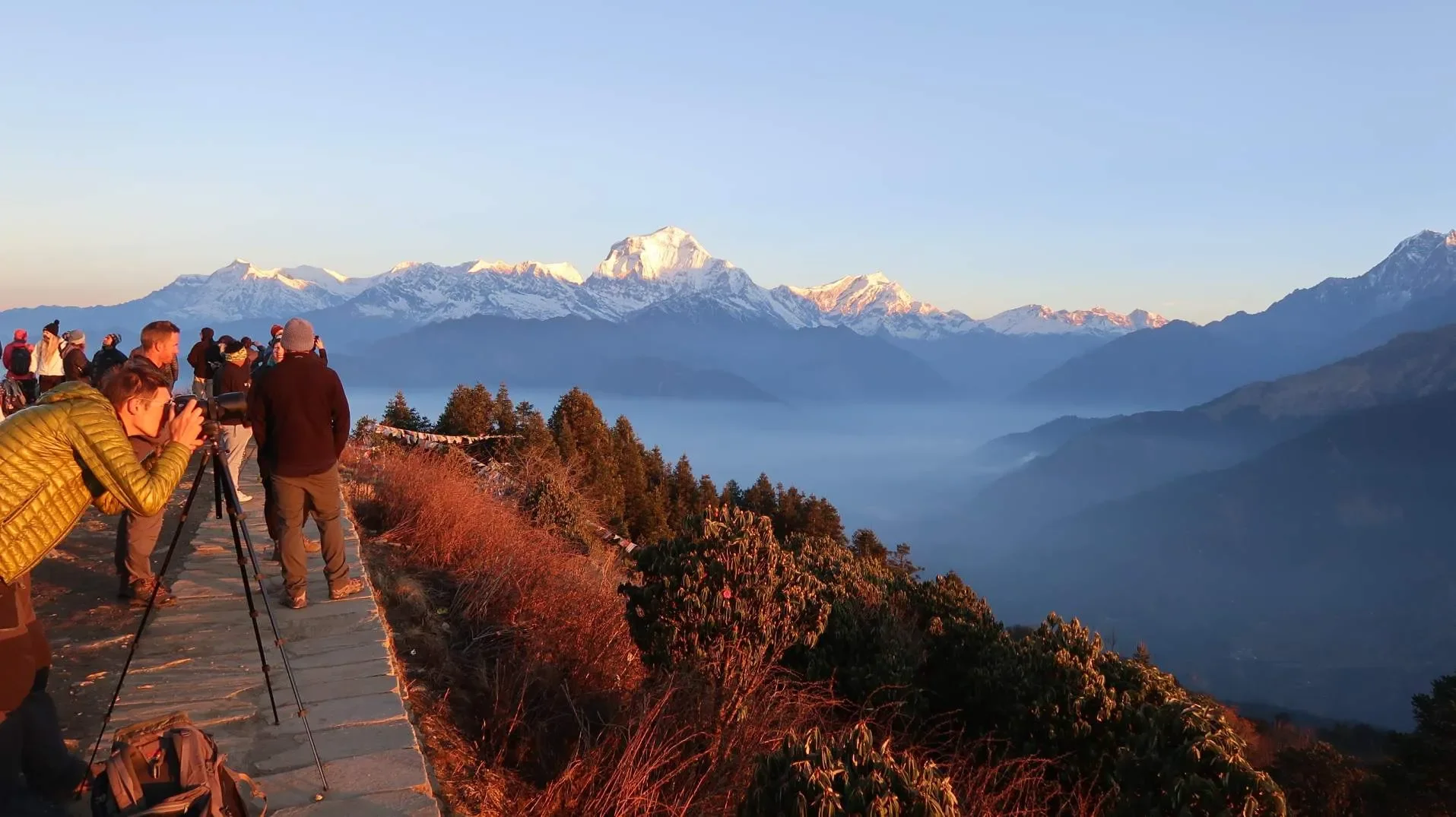
Source: Sylwia Bartyzel / Unsplash, Excited travelers gather at the famous Poon Hill viewpoint shelter to photograph the iconic Himalayan sunrise.
The best months for a clear Poon Hill sunrise are October and November in autumn and March to April in spring. Autumn delivers the crispest, most reliable skies after the monsoon, while spring adds blooming rhododendron forests in red, pink, and white along the trail.
Our team consistently rates autumn as the safest bet for guaranteed mountain views. If you want flowers and slightly warmer days, spring wins. Read our breakdown of September vs October trekking conditions if you are deciding between shoulder windows.
A little inspiration for your next trip
Get travel ideas and local experiences from My Easy Guide in your inbox.
Spam free. Unsubscribe anytime. We respect your privacy.
Season
Months
View Reliability
Crowds
Autumn
Oct - Nov
Excellent, crisp skies
Very high
Spring
Mar - Apr
Very good, rhododendron bloom
High
Winter
Dec - Feb
Clear but very cold, possible snow
Low
Monsoon
Jun - Aug
Cloudy, frequent washout
Very low
For deeper monthly planning, see our guide to trekking in October, generally the single most popular month in Nepal.
Ghorepani Poon Hill Trek Permits and Costs for 2026
The Poon Hill trek sits inside the Annapurna Conservation Area, so you need two documents: the ACAP permit and the TIMS card. There is no Restricted Area Permit here because this is not a controlled border zone.
The ACAP permit costs NPR 3,000 (approx. $23 USD) for foreigners and NPR 1,000 for SAARC nationals. The TIMS card costs NPR 2,000 (approx. $15 USD) for foreigners and NPR 1,000 for SAARC nationals. Both are issued in Kathmandu or Pokhara.
You will also need a Nepal entry visa: $30 USD for 15 days, $50 USD for 30 days, or $125 USD for 90 days on arrival. For full document details read our TIMS card guide and our overview of Nepal trekking rules and costs.
For a full price breakdown of this specific route, our Poon Hill trek cost guide covers guide fees, lodges, and transport ranges.
Do You Still Need a Guide in 2026?
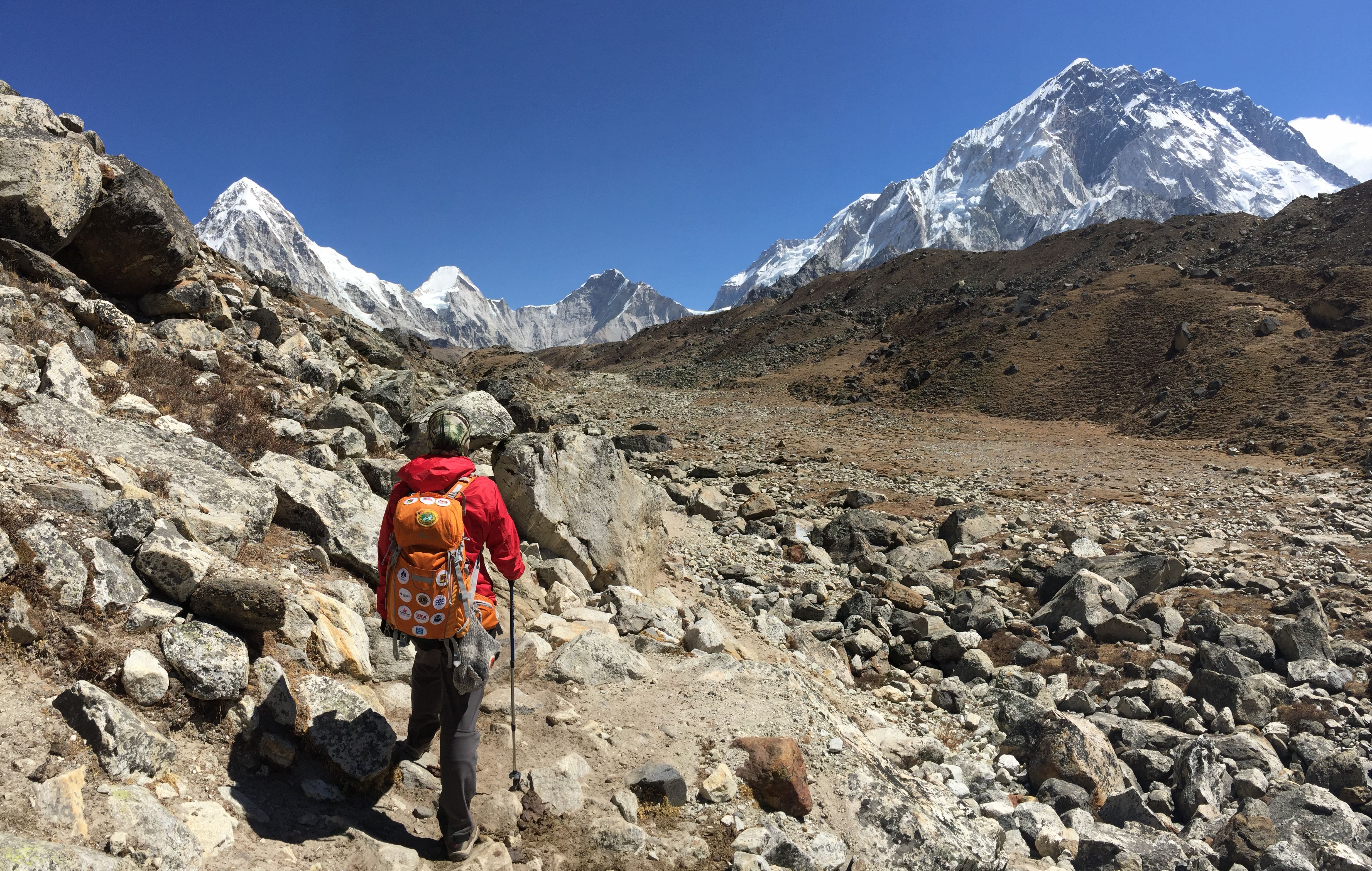
Source: Sherine, Trekker explores rocky Himalayan trail in Khumjung, Nepal with snow-capped peaks.
Nepal continues to enforce its rule requiring licensed guides for national park and conservation area treks in 2026. While Poon Hill is low and well-trodden, the Annapurna region falls under this framework, so you should trek with a registered, licensed guide and carry valid permits.
A guide handles checkpoints, sorts lodge bookings in peak season when beds fill fast, and reads the weather to pick the best sunrise morning.
Because independent solo trekking is banned, solo travelers must hire a private guide through a registered agency, which provides a massive safety net.
Most Poon Hill treks start with a drive from Pokhara to either Nayapul or directly to Ulleri and Banthanti by jeep. Private jeep hires and shared transport rates fluctuate with fuel and season, so verify live prices locally rather than trusting old quotes online.
Be aware that jeep roads now reach deep into the lower valley. Wherever possible, ask your guide to route you onto the older walking trails to avoid road dust and vehicle traffic. Pokhara itself is worth a day or two; browse things to do in Pokhara before or after your trek.
Cash, Connectivity and Trail Charges
Carry enough Nepalese Rupees in cash. There are no reliable ATMs on the trail once you leave Pokhara, so withdraw what you need before departing. Lodges add charges for extras most travelers forget to budget.
Expect to pay 200 to 700 NPR each for charging a phone or power bank, a gas-heated hot shower, and Wi-Fi access. For mobile signal, Ncell gives strong coverage across the Annapurna region, so pick up a local SIM in Kathmandu or Pokhara.
Altitude and Safety
Poon Hill tops out at 3,210 meters, low enough that serious altitude sickness is uncommon. Still, the climb from Ghorepani gains height quickly, so walk slowly and stay hydrated. If you continue onward to higher routes, follow the rule of not increasing sleeping elevation by more than 300 to 500 meters per day above 3,000 meters.
Skip plastic bottled water to protect the trail; bring a reusable bottle with a UV purifier or chlorine dioxide drops. Make travel insurance covering helicopter evacuation up to 6,000 meters a non-negotiable. Read our primer on altitude sickness to stay safe.
Eat Well: Stick to Dal Bhat
On the trail, prioritize the classic Dal Bhat, lentil soup, rice, and vegetable curry. It is freshly cooked, high-energy, and most lodges offer free refills. Meat is carried up by foot over days without refrigeration, so vegetarian dishes are the cleaner, safer choice.
Cultural Etiquette on the Trail
Always walk clockwise around mani walls, stupas, and chortens, keeping the structure on your right. Remove shoes and hats before entering any monastery, and never photograph inside prayer halls unless a resident monk grants permission.
At the end of your trek, tipping the crew is culturally expected. A standard range is 10% to 15% of your total trek cost, distributed among your guide and porters.
Is It Still Worth the Hype?
Honest answer: yes, with caveats. The sunrise panorama of Dhaulagiri, Annapurna South, Machapuchare, and Nilgiri is genuinely world-class, and the trek packs it into just 3 to 5 days. That accessibility is why it stays popular.
The downsides are real. The summit gets crowded in peak season, and jeep roads have eroded the wilderness feel of the lower trail. If you crave solitude, consider the quieter Mardi Himal trek or the Khopra Ridge trek as alternatives. For first-time trekkers wanting a reliable taste of the Himalaya, Poon Hill still delivers. See the full route in our Ghorepani Poon Hill trek guide.
Frequently Asked Questions
How fit do I need to be for Poon Hill?
Moderate fitness is enough. The hardest sections are stone staircases like the climb to Ulleri and the dawn ascent itself. Anyone who walks regularly can manage it at a steady pace.
Can I do Poon Hill without a porter?
Yes, many trekkers carry their own daypacks. A porter is optional and costs extra, but it makes the steep stairs far more comfortable.
Is there Wi-Fi in Ghorepani?
Yes, most lodges offer Wi-Fi for a fee of roughly 200 to 500 NPR. Ncell mobile data is often faster and more reliable.
How cold is it at the top before sunrise?
Expect near-freezing temperatures with wind chill, especially in winter. Wear a warm jacket, gloves, and a hat for the climb.
Can I combine Poon Hill with Annapurna Base Camp?
Yes, this is a popular extension. Many trekkers add Poon Hill to the start of an Annapurna Base Camp trek.
Are credit cards accepted on the trail?
No. Lodges, kiosks, and checkpoints are cash only. Carry sufficient Nepalese Rupees.
What is the lowest crowd month?
December through February sees the fewest trekkers, with clear but very cold mornings and occasional snow on the trail.
Does it ever snow on Poon Hill?
Yes, in winter the staircase and viewpoint can be snow-dusted, which makes for stunning photos but slippery footing.